Ambiguity, Cognition, Learning, Teaching,
and Design
Workshop
and special panel session held at the International Conference
of the Association for Educational Communications and Technology,
Anaheim, California, October 22-25, 2003, and organized by the
Learning Development Institute
"What
is not surrounded by uncertainty cannot be the truth."
Richard
Feynman, cited by Timothy Ferris in M. Feynman (2005), Perfectly
reasonable deviations from the beaten track: The letters of Richard
P. Feynman. New York: Basic Books.
The above event brought together
a group of people, representing different disciplines and connected
in different ways to the practice and theory of cognition, learning,
teaching and design, around the issue of ambiguity. The concept
of ambiguity occurs relatively infrequently in the literature
on learning and teaching. A Web search intersecting “learning”
and “ambiguity” reveals a certain dominance of the
concern with ambiguity in the literature on learning algorithms.
As regards human learning, the concept of ambiguity gets mentioned
in connection with learning styles (some learners get turned
off when confronted with too much ambiguity). “Tolerance
of ambiguity” is a concept employed by theoreticians who
deal with the learning of foreign and second languages. The concept
also occurs in some of the literature on problem-based learning.
It may also be linked to issues of a more philosophical nature,
such as the question, “Can we really understand the world?”
There are instances in which our ordinary (Aristotelian) logic
is an insufficient basis for the advancement of understanding.
Some of the literature on transdisciplinarity deals with this
issue and proposes (e.g. Nicolescu, 2002) a logic based on the
“included middle” (as opposed to the excluded middle
in Aristotelian logic). Another connection here is with what
physicists have known – and had difficulty to come to grips
with – since early in the last century – that at the
level of description of nature that is incommensurate with the
levels for which common language was developed there is complementarity
of knowledge in the sense that, in order to know with precision
one thing, like the speed of a particle, it becomes fundamentally
impossible to know a complementary aspect, such as the position
of that same particle at the same time. Yet another area of ambiguity
occurs when people’s emotions lead them in a different direction
than their cognition. This issue is well known to researchers
who look into human behavior regarding the prevention of HIV/AIDS
or smoking.
These are but a few areas where
one can see that a discussion around the theme of ambiguity in
learning and instruction could be highly relevant. The idea for
the workshop wasn thus to look at ambiguity in the first place
as a fact of life, rather than as something that should be avoided
in the instructional context. If in real life we have to deal
with ambiguity in its many guises all the time, then the question
is, "What should one do in the learning environment to optimally
prepare people for life in an ambiguous world?"
REFERENCE
Nicolescu, B. (2002). Manifesto
of transdisciplinarity. New York: SUNY Press.
The following persons contributed
to the workshop in Anaheim (the names of those who were unable
to be physically present but who contributed with a paper are
preceded by an asterisk):
Muriel Visser, who researches adolescent health related
behavior, particularly in response (or lack thereof) to the threat
of HIV and AIDS;
* John Shotter, who is probably best known for his
contributions to our thinking about learning as a social and
dialogic phenomenon;
Yusra Laila Visser, whose research focuses on problem-oriented
learning;
Gil Suzawa, whose work and research focuses on
the teaching of economics with ambiguity in mind;
Ron Burnett, who is too broadly defined to be captured
in one short phrase, but who was expected to contribute (and
indeed he did) from the perspective of his experience as an administrator
of a significant institution that introduces young and not so
young people to the world of art and design, his experience as
an educator, and his scholarship in the communications field;
* Gordon Rowland, known for his contributions to thinking
about learning and design from a system theoretical perspective
as well as his research into the factors that make learning powerful.
Jan Visser, who expected his contribution to have
something to do with his current interest in questions about
the development of “mind” (as opposed, or rather in
addition to specific competencies) and with his background as
a theoretical physicist and someone who is conversant with the
fascinating history of science since its known early beginnings
in Mesopotamia as well as by his work in an international development
context.
In addition, two discussants,
Brent Wilson of the University of Colorado and Kyle
Peck of the Pennsylvania State University, contributed to
the dialogue during the conference session by providing their
reflections on the various written contributions by the above
authors.
Title: Tolerance of Ambiguity Description: The concept of ambiguity occurs relatively
infrequently in the literature on learning and teaching. A Web
search reveals a certain dominance of the concern with ambiguity
in the literature on learning algorithms. As regards human learning,
the concept of ambiguity gets mentioned in connection with learning
styles; the learning of foreign and second languages; and problem-based
learning. It may also be linked to epistemological questions
regarding how we know the world and advance our understanding
of it. Physicists have long known that at a level of description
of nature incommensurate with the levels for which common language
evolved, there is complementarity of knowledge in the sense that,
in order to know with precision one determining aspect of a phenomenon,
it becomes fundamentally impossible to determine a complementary
aspect of it. Yet another area of ambiguity occurs when people’s
emotions lead them in a different direction than their cognition.
This issue is well known to researchers of human behavior regarding
the prevention of HIV/AIDS or smoking. All these examples suggest
that ambiguity is a fact of life to be lived with rather than
to be avoided. The question then is, "What should one do
in the learning environment to optimally prepare people for life
in an ambiguous world?" Length: 2 Hours
Time: 1:15 pm-3:15 pm
Date: 10/23/03
Location: Hyatt Regency-Terrace A&B Session Type: Concurrent Facilitator and Key Presenter: Dr. Jan Visser, President,
Learning Development Institute
The following papers were contributed
by the participants in this exercise. They are presented, following
the alphabetical listing of the author names below, in the chronological
order in which they were received.
Ron
Burnett - Ambiguity/Language/Learning (text - received October 21, 2003 -
as well as PowerPoint presentation)
Gordon
Rowland - A little
ambiguity can go a long way (received July 21, 2003)
John
Shotter - The
necessity for ambiguity if we are to achieve specificity in communication (received October 19, 2003)
Gil
Suzawa - Ambiguity
and teaching economics
(received October 16, 2003)
Jan
Visser - Science
and ambiguity: Have we thrown the key away? (received October 19, 2003)
Muriel
Visser - "Inverted
commas": A critical reflection on ambiguity in the context
of HIV/AIDS (received
October 20, 2003)
Yusra
Laila Visser -
Ambiguity in learning: Issues and implications for instructional
design (received October
22, 2003)
A Little Ambiguity Can Go a
Long Way
Gordon Rowland
Ithaca College and Learning
Development Institute
There are at least two ways the
term ambiguity can be defined and used, and these point toward
different views of the processes of learning, teaching, and helping
with organizational change. I refer to these as allopoietic and
homeopoietic, elsewhere (Rowland, 2003), and I will return to
those terms after briefly exploring the views. The major point
I will attempt to make is that a modest level of ambiguity can
have very positive effects.
According to the Oxford English
Dictionary (Compact OED, 1991), ambiguity can mean "wavering
of opinion, hesitation, doubt, uncertainty, as to one's course"
or it can mean "capable of being understood in two or more
ways, double or dubious signification." Similarly, ambiguous
can mean "doubtful, questionable, indistinct, obscure, not
clearly defined" or it can mean "admitting more than
one interpretation or explanation; of double meaning or of several
possible meanings; equivocal; of doubtful position or classification,
as partaking of two characters or being on the boundary line
between."
The definitions relating to wavering
and uncertainty point toward an attitude of avoidance. As a learner,
one wants clear presentation of facts and answers to questions,
and, as a worker, one wants clear management direction. Consequently,
the teacher or manager is seen as the source of expertise, and
perhaps vision, and is responsible for controlling processes
that lead to defined outcomes.
In contrast, the definitions
relating to multiple interpretations and boundary spanning point
toward an attitude of acceptance. A learner would understand
that concepts and language are human constructions and would
look for guidance from someone with more experience, as opposed
to "truthful" answers from an expert source. A worker
would look for performance support (and/or removal of obstacles)
in achieving mutually agreed upon goals, as opposed to orders.
Both would expect to have input into decisions and a certain
degree of self-direction, so, the teacher and manager would take
the role of respectful facilitator.
The distinction between definitions,
and thus selection of approach, may stem from one's view as to
the nature of human individuals and organizations. They can be
seen as simple deterministic systems, for which a limited number
of cause-effect relationships can be identified and translated
into predictions and prescriptions for achieving desired outcomes.
Or they can be seen as complex adaptive systems that self-organize
through complex and dynamic interrelationships and are characterized
by nonlinear processes and unpredictable outcomes. Further, the
latter view may be amended to see humans and organizations as
complex creative systems that evolve with human intention, as
opposed to only adaptation to changing circumstances in their
environment.
Support for a complexity (complex
adaptive or complex creative) rather than simplicity (simple
deterministic) perspective is growing through a confluence of
a number of sources: new sciences and their application to living
systems (e.g., Gell-Mann, 1994; Strogatz, 2003; Capra, 2002;
Morowitz, 2002); behavior of experts in solving problems (e.g.,
Akin, 1994; Rowland, 1994); powerful/meaningful learning experiences
(Perry, 2002 Rowland & DiVasto, 2001; Rowland, Hetherington,
& Raasch, 2002; Visser & Visser, 2000,); learning theories
(e.g., Wilson, 1996); as well as everyday social interactions
(Stacey, 2001). However, approaches to learning, teaching, and
organizational change based on a complexity view are just now
appearing in the literature and are largely speculative (e.g.,
Shaw, 2002; Rowland, 2003)
These approaches can be characterized
as either allopoietic-making for others-or homeopoietic-making
with others (Rowland, 2003). The allopoietic approach is quite
familiar to all of us who have been "schooled" or who
have worked in a traditional management hierarchy. In the context
of teaching and learning, it refers to the design and delivery
of instruction, literally meaning the furnishing of knowledge.
On the other hand, the homeopoietic approach calls for mutually
constructing knowledge (and organizations) through the intentional
complex responsive processes of relating (see Stacey, 2001).
This involves what has variously been called living in the midst
of change, in the creative tension of apparent opposites, with
the paradox of being simultaneously in and out of control, in
far from equilibrium states, at the edge of chaos, in flow or
liminal states, in a space for novelty, or in a network characterized
by certain levels and types of connectivity-not too much or too
little (e.g., Barabási, 2002; Rowland & Wilson, 1994;
Stacey, 1996; Streatfield, 2001; Strogatz, 2003) This special
condition contains the simultaneous potential for continuity
(identity) and transformation (Stacey, 2001), and, when a system
is in it, outcomes can be dramatically affected by minor perturbations
(e.g., Waldrop, 1992). It is where new order (knowledge, organizational
capability) emerges (Morowitz, 2002), and it is thus an important
point of leverage for evolutionary guidance (Banathy, 2000).
However, given that situations are unique and outcomes are unpredictable,
the homeopoietic approach involves sensitivity to local conditions
and modest, indirect attempts to influence them, as opposed to
general control and direction from a centralized source.
The implications for learning,
teaching, and assisting with organizational change are numerous.
Here I'll list some responses to Jan Visser's initial question
to us: "What should one do in the learning environment to
prepare people for life in an ambiguous world?" Taking a
complexity perspective, one could:
immerse learners in activity
in authentic context
start from concrete (and thus
complex) experience rather than the abstract constructs of a
domain; move to the abstract through iterative cycles, diminishing
scaffolding over time
resist simplification
help to hold anxiety (a role
for teachers and managers)
teach systems thinking, e.g.,
complexity, nonlinearity, unpredictability (e.g., how long-term
outcomes in a complex system cannot be accurately predicted,
how ambiguity can lead to new knowledge)
encourage mindfulness (see Weick
& Sutcliffe, 2001) and reflection in and on experience
work toward alignment of cognition
and emotion-a whole systems approach (e.g., bodymind as one)
treat learning outcomes as designs
and thus as "expected unexpected" (see Nelson &
Stoltermann, 2003)
help learners and workers examine
ambiguity as a source for understanding the richness of a unique
situation
use ambiguity as a basis for
local, indirect action
treat ambiguity as a sign that
the situation may be shifted dramatically by small actions and,
therefore, one needs to respect this sensitivity and exercise
great care (for example, a teacher should recognize that ambiguity
is where a breakthrough or breakdown is possible, and thus where
careful guidance is necessary)
distinguish utter confusion
from useful creative tension (which implies competencies that
are not regularly found in lists put out by professional societies)
encourage AND in addition to
OR thinking
see ambiguity as an opportunity
for expansion of the zone of proximal development
see ambiguity as an opportunity
for new order
promote sustainability and authenticity
of process as more important than efficiency of process and effectiveness
of product.
A little ambiguity (not a lot)
can go a long way (have a non-proportional outcome) in a positive
direction (more probable through conscious intention), so we
should look at it positively.
I hope these thoughts are useful
to the group. I look forward to reading other contributions here
on-line and regret being unable to attend the event.
References
Akin, O. (1994). Creativity in design. Performance Improvement
Quarterly, 7(3), 9-21.
Banathy, B. H. (2000). Guided
evolution of society. NY: Kluwer Academic.
Barabási, A. (2002). Linked:
The new science of networks. Cambridge, MA: Perseus Publishing.
Capra, F. (2002). The hidden
connections: Integrating the biological, cognitive, and social
dimensions of life into a science of sustainability. NY:
Doubleday.
Compact Oxford English Dictionary (2nd Ed.) (1991). Oxford: Clarendon
Press.
Gell-Mann, M. (1994). The
quark and the jaguar: Adventures in the simple and the complex.
NY: W. H. Freeman and Company.
Morowitz, H. J. (2002). The
emergence of everything. Oxford: Oxford University Press.
Nelson, H. G., & Stolterman,
E. (2003). The design way: Intentional change in an unpredictable
world. Englewood Cliffs, NJ: Educational Technology Publications.
Perry, D. L. (2002). Profound
learning: Stories from museums. Educational Technology,
42(2), 21-25.
Rowland, G., & DiVasto, T.
(2001). Instructional design and powerful learning. Performance
Improvement Quarterly, 14(2), 7-36.
Rowland, G., Hetherington, J.,
& Raasch, J. (2002). The individualized nature of powerful
learning experience. Educational Technology, 42(2),
26-30.
Rowland, G. (2003). Designing
with: A homeopoietic ethic for organizational change. Draft of
invited paper for special issue of Systems Research and Behavioral
Science.
Rowland, G. (1992). What do instructional
designers actually do? An initial investigation of expert practice.
Performance Improvement Quarterly, 5(2), 65-86.
Rowland, G., & Wilson, G.
F. (1994). Liminal states in designing. Performance Improvement
Quarterly, 7(3), 30-45.
Shaw, P. (2002). Changing
conversations in organizations: A complexity approach to change.
London: Routledge.
Stacey, R. D. (1996). Complexity
and creativity in organizations. San Francisco: Berrett-Koehler.
Stacey, R. D. (2001). Complex
responsive processes in organizations: Learning and knowledge
creation. London: Routledge.
Streatfield, P. J. (2001). The
paradox of control in organizations. London: Routledge.
Strogatz, S. (2003). Sync:
The emerging science of spontaneous order. NY: Hyperion.
Visser, J., & Visser, Y.
(2000). The learning stories project. Retrieved May 22,
2003, from the World Wide Web: http://learndev.org/LearningStories.html
Waldrop, M. M. (1992). Complexity:
The emerging science at the edge of order and chaos. NY:
Touchstone.
Weick, K. E., & Sutcliffe,
K. M. (2001). Managing the unexpected: Assuring high performance
in an age of complexity. San Francisco: Jossey-Bass.
Wilson, B. G. (Ed.) (1996). Constructivist
learning environments: Case studies in instructional design.
Englewood Cliffs, NJ: Educational Technology Publications.
This paper provides a discussion
of the "full and proper sense" of the philosophical
concept of ambiguity (uncertainty). It also provides a discussion
of how the concept can help mold the practice of teaching college-level
economics in an effective manner with some examples taken from
the author's own teaching practices. Since the inquiry utilizes
references from many disciplines and is quite holistic in nature,
one could say that it is consistent with the mode of transdisciplinary
thought as expounded by Basarab Nicolescu (2001).
Introduction
I once presented a paper entitled
"Teaching Introductory Economics with Some Ambiguity"
(2000) at a conference on teaching economics. One question raised
in response to the title of the paper was: "Do we need more
ambiguity in the way we teach economics?" Because the focus
of my paper was on statistical assessment of the efficacy of
what I was doing in my college-level course, my response to the
question was to tersely say that the term "ambiguity"
served as a "code word" for more of a constructivist's
approach utilized in my course design and teaching conduct. In
retrospect, I realized that there did not yet exist a strong
association in most economists' mind between the word "ambiguity,"
in its lexical meaning of "uncertainty," and the nexus
of teaching and learning based on a constructivist theory of
knowledge. Thus some clarification of the "full and proper"
sense of the concept of ambiguity and an elaboration of how it
can influence our teaching practices were warranted.
1. The Different Senses of Ambiguity
Do I believe that we need more
ambiguity in the way we teach economics? The answer is yes and
no. It clearly depends on the sense in which the term is being
used. In general, instructors of economics make extensive use
of the blackboard and verbal explanations. This has been dubbed
"chalk and talk." (Becker and Watts, 1996) Ambiguity
can occur in the language that we use to teach. In semantics,
ambiguity refers to a word, phrase, or sentence having more than
one literal meaning. Consider the statement: "I'll give
you a ring tomorrow." The sentence has more than one literal
(lexical) meaning because a particular word in the sentence (i.e.
a component) has more than one meaning. The word "ring"
could refer to an engagement ring or to a call on the telephone.
In this case, semantic over-determination prevails if only one
meaning is intended. Some process of "disambiguation"
would have to be undertaken to delineate the intended message.
(Bach, 1994) In many cases, the context in which the statement
is made would serve that purpose. If not, there are some formal
techniques for disambiguation that can be applied. Over-determination
is not intentional [except in cases were "strategic ambiguity"
is being purposefully adhered to, see for example, D'Amato (1996)]
and needs to be corrected. You might say that I made this kind
of mistake in my use of the term "ambiguity" in the
title of my conference paper with the assumption that the reader
would interpret it as I did. I would say that we need less of
this kind of semantic ambiguity in our teaching of economics.
Getting rid of unintentional
ambiguities, however, is not an easy task. The process of expanding
economic knowledge makes extensive use of metaphors. (Henderson,
1998) When metaphors are "alive," they surprise readers
and listeners and are clearly understood in a non-literal manner.
After awhile however, what was once a metaphoric use of a word
becomes a literal use. Examples of "dead" metaphors
abound in the discipline of economics, e.g. liquidity, elasticity,
and depression. In this historical context, the problem of disambiguation
is especially acute in introductory economics courses, as students
may be more accustomed to a metaphor's original literal meaning
and must now be somewhat indoctrinated to the word's technical
meaning in economics. Dead metaphors certainty do not help students
understand (learn) economic concepts and, pedagogically speaking,
new (live) metaphors are generally required for this purpose.
In a sense, metaphors are both a boon and a bane to professional
economists. I would say that they are "delightful"
when you are doing path-breaking research developing new concepts,
but a "pain in the neck" (metaphor intended) when,
as an educator, you have to help students understand existing
economic concepts which are essentially enshrined in textbooks
in the form of outdated metaphors.
Another kind of semantic ambiguity,
which I believe we should have less of in the teaching of economics,
is structural or logical, ambiguity. This sense of ambiguity
relates to the manner in which language and mathematics can be
(foundations) and are (applications) used in reasoning processes.
Here we are dealing with the "chalk" aspect of teaching
as well as the "talk" aspect. In language, a sentence
or phrase can have more than one meaning not because any words
in the expression has more than one meaning, but because of the
structure, or arrangement, of words in the sentence (syntax)
is ambiguous. A good example of this is the sentence: "Everybody
loves somebody." There are at least two distinct propositions
embodied in this sentence. One proposition is that each member
of the group loves another member of the group. (The mapping
is within the set.) The alternative proposition is that all members
of the group love a particular member of another group. (The
mapping is between sets.) Thus, when it comes to the matter of
determining the truth or falsity of the sentence, which of the
propositions are we supposed to evaluate? Is it the first or
the second?
One can see that the above mentioned
meaning of ambiguity implies "vagueness" in both symbolic
and linguistic (logical) reasoning and is not generally considered
desirable in teaching economics. [For a more comprehensive discussion
regarding ambiguity and vagueness refer to Keefe and Smith (1996).
Also, interested individuals may want to read Empson's (1947)
exposition on (seven) types of ambiguities in literature.] Of
course there are some exceptions to the rule here. From a pedagogical
perspective, we may find it useful to employ examples of "bad"
logic to teach "good" logic. In these instances, we
are utilizing the concept of "fallacies" in our teaching.
The teaching task here is to use someone else's fallacy as an
example of what not to do, but not to unintentionally create
an example of fallacy on your own. (This normative statement
is biased towards the principle that you "ought" not
to purposely distort the purity, or accuracy, of the information
being transmitted to the pupils.)
2. Greek Philosophy and the Foundations
of Western Logic
So far I have said "no"
to the sense of ambiguity as semantic ambiguity, i.e. multiple
meaning of words, phrases or sentences. When I say, "with
some ambiguity," what sense of ambiguity do I want to infuse
the teaching of economics with? The lexical meaning that I have
in mind is "uncertainty." For the "full and proper
sense" of this meaning of ambiguity, we need to explore
the roots of our Western way of thinking--Greek philosophical
thought. Greek philosophers grappled with three fundamental concepts
of epistemology (and ontology): presupposition (necessity), ambiguity
(possibility) and negation (impossibility). In one line of Greek
philosophical inquiry (Protagorean doctrine, or commonly referred
to as "sophistry"), the three epistemological concepts
where considered to be completely autonomous, i.e. not reducible
to any of the other two concepts. However, starting with Aristotle,
presupposition and negation gained supremacy in Western logic
and this perspective on logic has prevailed for over two millenia.
Some very thought-provoking reinterpretation of Plato's dialogue
entitled Theaetetus is shedding new insight on the Protagorean
doctrine and how it relates to human knowledge. I am particularly
influenced by Rosemary Desjardins' The Rational Enterprise: Logos
in Plato's Theaetetus. In a chapter specifically entitled, "Ambiguity,"
she states:
The ostensible subject of the
Theaetetus is introduced by what
must surely be one of the most lightheartedly ironic of all Plato's
understatements: "I am puzzled about one small matter…this
is
what I am perplexed about and cannot fully grasp by my own efforts:
what knowledge is." To
all appearances, the question is never answered.
In reality, so this study will
argue, we are provided with a carefully
worked-out answer---an answer
recognized as explicit, however,
only if the dialogue is taken
self-referentially. [p. 15]
According to Desjardins, "…the
cross-examination of Socates' dream points to the sense in which
knowledge must be recognized, and actually achieved, as not only
many but also 'one': an emergent whole born in generative interaction
between its constituent elements." [p.163] In this "full
and proper sense" of the word, ambiguity can be expressed
as the paradoxical notion of unity and multiplicity, or nothing
and something, and it is the self-referencing foundation of our
knowledge.
Another interpretation of Plato's
Theaetetus is provided by Ronald M. Polansky 1992). He claims
that: " For Plato the Theaetetus is quite complete. It considers
every promising account of knowledge, of ignorance, and of account,
and even the most extreme options." [p.244] He further states
that: "The commentary often resorted to deliberate ambiguity
or different perspectives of the different interlocutors to explain
how there might be several layers of meaning. Not only does this
add to the comprehensiveness of the dialogue's treatment of its
themes, but it also reconciles many disagreements of commentators."
[p. 245]
Furthermore, if we utilize the
refractive relationship (i.e. the subject-predicate perspective)
between existence (being) and cognition (mind or consciousness),
we find that we can relate "ambiguity" to "possibility"
in their respective "full and proper" senses. Similar
to Plato's examination of the multiple layers of knowledge in
search of the ultimate foundation of knowledge (episteme), the
late Italian philosopher by the name of Nicola Abbagnano searched
for the proper sense of the word "possibility" as an
essential foundation for his own "radical" existential
philosophy. According to the American translator, Nino Langiulli
(1992), Abbagnano's positive definition of possibility is "…that
which can exist or [and] not exist and [which] obtain only as
such." Another, somewhat negative, formulation of the third
sense of possibility might be this: A possibility is neither
that which is necessary nor that which is impossible." [p.
127] Thus, it would appear that Abbagnano affirmed the autonomy
of possibility in the ontological sense. Possibility in this
"proper sense" could be interpreted as the paradoxical
"being and not being " or "becoming," i.e.
"some degree of being and not being. This suggests the idea
of a spectrum notion of existence. In metaphorical terms, everything
is neither "black" nor "white," but a shade
of "gray." Returning to epistemological terms, cognition
would not be complete (i.e., as comprehensive or "full"
as it possibly could be) unless it entails "black,"
"white" and all the shades of "gray" as well.
Thus, restricting cognition to either black or white would constitute
"incomplete" cognition as opposed to "complete'
or "full" cognition.
According to physicist Basarab
Nicolescu (2001), the logical system that has served as the foundation
of virtually every scientific discipline's structure of inquiry
up to now has been the logic of the "excluded middle."
The proper ambiguity (possibility) concepts are essentially "ignored"
in the axiomatic system that generates all of the logical structures
that are used by the various scientific disciplines, including
economics. The three postulates (axioms) of the prevailing logic
are (1) The axiom of identity, i. e. A is A. (2) The axiom of
non-contradiction, i.e. A is not non-A. and (3) The axiom of
the excluded middle, i.e. There does not exists a term T such
that T is both A and non-A or is not both A and non-A. With the
third postulate of this prevailing axiomatic approach to scientific
inquiry, there is no way of over-riding the mutually exclusive
nature (either/or) of reasoning cognitively in any scientific
discipline using this logical system. The alternative is to change
postulate (3) to (3') The axiom of the included middle, i.e.
There does exist a term T, etc. etc.
There is an old adage: "If
it works, why fix it?" If the Old Logic has been so useful
in assisting the various disciplinary sciences in increasing
knowledge, why change the rules of inquiry at this juncture?
But that's just it, the Old Logic is impeding progress in the
scientific discipline of physics and a few other disciplines.
Theoretical physicists are not making much progress in developing
new knowledge of the physical universe beyond the level of what
can be called quantum mechanics. In their concerted attempts
to resolve the discontinuities that they have encountered in
their endeavors to expand the knowledge of their field of inquiry,
they (or at least some of them) have reached the point of seriously
challenging the basic postulates of their science. Thus, the
perception of the problem-solving utility of altering the third
postulate of the Old Logic has gained momentum in theoretical
physics. And some physicists have also become advocates for the
"unification of (human) knowledge" under the rubric
of the New Logic, i.e. the logical system with the "included
middle." An example of this is the "transdisciplinary"
category proposed by physicist Basarab Nicolescu (2001) that
serves as an umbrella concept for an extensive range of holistic
research endeavors. A couple of competing notions are "consilience"
proposed by entomologist Edward O. Wilson (1998) and "beyond
social constructivism" ("knowing of the third kind")
as outlined by sociologist John Shotter (1999). For the purpose
of this essay, I have chosen the phrase "transdisciplinary
inquiry" to signify this "quest" for the generation
of new knowledge.
3. Perspective of Complexity Theory
As an interesting historical
example of how advancement in the knowledge of any one discipline
occurs with some conceptual transfers from other disciplines
is the case of the development of the concept (theory) of complexity.
In the early 1960s, as a result of working on the problem of
statistical estimation design with respect to time-series data
on cotton prices the mathematician Benoit Mandelbrot (1963) introduced
an interesting new idea, which is now commonly accepted under
the rubric of complexity theory. Mandelbrot confronted a paradox
in his research. The nature of the paradox is as follows: The
science of statistical analysis conforms to the logic of the
"excluded middle." Very briefly, this congruence between
the science of statistical estimation and Old Logic is based
on the theory of temporal convergence to some limit mean value
(normal probability distribution). On this concept of limit mean
value rested the truth or falsity of the underlying proposition.
In other words, it may not be feasible to determine the truth
or falsity of a proposition immediately (via deductive reasoning),
but in the long-run one can infer (inductive reasoning) the proposition's
truth or falsity. But this was all contingent on convergence
to the limit mean value. What if convergence does not occur in
the long run? Which is what was apparently the case in Mandelbrot's
statistical analysis problem. Then one confronts a paradox or
ambiguity (lack of certainty).
Mandelbrot's suggestion as to
how this ambiguity could possibly be resolved is where the "transdisciplinary
power" of the complexity idea lies. His reference to the
possibility of deriving a second order set of laws via more powerful
empirical techniques is the precursor of the notion of another
physical "reality" for which these new laws would apply.
Another way of putting the matter is that Mandelbrot was proposing
a "radical" idea in applied empirical analysis, one
that conflicted with the dominant classical logical system (Old
Logic). One can also say that as a human being, Mandelbrot manifested
a remarkably "positive attitude" towards ambiguity
(uncertainty). By "embracing ambiguity," he has contributed
to the restoring the appropriate role of ambiguity (along with
presupposition and negation) in a New Logic. And this New Logic
is beginning to have a pervasive impact on many scientific disciplines.
[For this subsection, I have relied heavily on an essay by biologist
G. Stent (1978).]
4. Disciplinary Convergence (The Unity
of Knowledge Thesis)
The proliferation of notions
like "transdisciplinary," "consilience" and
"knowing of the third kind" is an indication that an
amazing degree of disciplinary convergence is occurring in terms
of the progress of human knowledge. Many intractable problems
in various disciplines appear to be on the verge of yielding
to the onslaught of an amalgamation of new, powerful ideas from
across various disciplines, an example of which is the complexity
concept (theory) discussed previously. This has engendered hope
of the eventual unification of all human knowledge, which is
now divided among many disciplinary domains. You can imagine
this as a quest for the Grand Unification Theory of the Universe,
where the comprehensive theory would be able to explain both
the physical universe and the human mind. This is not as ephemeral
an idea as one might think. For example, cognitive scientist
George Lakoff and philosopher Mark Johnson (1999) have recently
published a volume entitled, Philosophy in the Flesh, in which
they propose and discuss the implications of the concept called
the "embodied mind." Their work is an attempt to resolve
the mind/body dichotomy that has long plagued philosophers and
scientists. The central thesis of their inquiry is quite interesting.
Basically, they argue that the refractive relationship that we
discussed earlier with respect to Greek philosophical domains
of ontology and epistemology is not as such, but is rather the
complementary of body and mind. That is to say, they are proposing
a theory of the unity of mind and body.
It is not my purpose in this
essay to try and cover all the salient aspects of this "convergence
of the disciplines" phenomena. However, germane to us in
this essay is the feedback loop from new theories of the human
mind to new psychological and cognitive science theories of knowledge
creation (building) and learning. And from there to how these
new theories of learning and knowledge creation can be applied
in the practice of learning and teaching. The constructivist
approach to learning and teaching is a vital part of this loop
as far as I am concerned. Furthermore, it is my contention that
the constructivist approach owes a lot to the re-integration
of the Pre-Socratic concept of ambiguity into the analytical
and affective thought processes of Western thinking.
5. Pedagogical Paradigms
Joseph Novak (1998) points out that every educational act consists
of five elements: (1) learner, (2) teacher, (3) knowledge, (4)
context, and (5) evaluation. We can construct concepts and theories
for each one of these elements and for various sets of these
elements. We also have the tendency to favor the application
of certain concepts and theories over others, and are therefore
categorized on the basis of schools of thought or pedagogical
approaches relative to the five elements mentioned above. The
distinction between a "constructivist" and a "connectionist"
is such a categorical differentiation.
There is a propensity in our
(ways of) thinking to treat the categories of constructivist
and connectionist as mutually exclusive in nature, i.e. either
one or the other. This can be attributed to the Old Logic that
underlies most of our cognitive processes regarding the transmission,
or exchange, of knowledge. In reality, "we are neither"
and "we are both." How can this be (true)? The answer
is ambiguity. We can conceive of ourselves as being a "spectrum"
of the two categories. At any given moment in time I am more
of a constructivist than a connectionist (or vice versa), and
this degree will more likely change with the passage of time.
However, many people are inclined to think of the categories
as you are either a constructivist or a connectionist but not
both. As the disciplines switch over from the Old Logic to the
New Logic, this mode of thinking will become less and less prevalent.
Thus, I use the phrase "with some ambiguity" as indicative
of the spectrum property of ambiguity. No doubt, however, there
are many people who would construe my usage of the phrase as
an example of "vagueness being compounded by imprecision."
In other words, the phrase represents an excellent example of
"fallacy" in my reasoning (based on the Old Logic).
It is apparent to me that incorporating ambiguity into human
thought processes implies that the human mind should have the
widest possible perspective, or scope regarding the creation
of knowledge and values (reasoning and judgements). This unrestricted
mind, for example, can utilize dialogic thinking (Wells, 1997)
as well as analytical thinking to create knowledge within the
structure of the New Logic. From this new logical perspective,
one mode of thinking does not have more legitimacy over any other
mode. Again, we must not think in terms of "all or nothing."
A mix of analytic and dialogic thinking may constitute an appropriate
way to create and re-create (constructivist's view) economic
knowledge. A concrete example of this in the field of teaching
economics would be the design and implementation of a course
entitled "Economics through Literature." Complemented
with the "Mathematics for Economist" course, a student
can then have access to economic knowledge via both analytic
and dialogic reasoning and not be confined to either one or the
other.
6. A Constructivist Theory of Knowledge
(Transmission)
As I understand it, on the question of how new knowledge (invention)
is constructed, there are no significant departures between the
constructivist and connectionist theories. Innovative knowledge
is created as a human response to some kind of complex challenge
(problem) via some kind of creative and critical thinking (cognitive)
process. The significant differences are in conjunction with
the question of how this new knowledge can then be transferred
from one person's mind to another person's mind, i.e. in explaining
how the "inventor" goes about teaching someone else
and how that someone else learns about the new idea (knowledge).
The connectionist view is that the new knowledge then becomes
meaningless information (data) that can be transmitted to another
person's mind that would then process the data in some cognitive
fashion to give it meaning.
The constuctivist's view on the
other hand is that the new knowledge created in one person's
mind must be reconstructed in some manner by another person's
mind and the degree of reconstruction would most likely vary
among different minds. An illustrative metaphor here is the "expert"
and the "novice." Again, if we apply ambiguity, we
can draw the perspective that in many practical instances, the
learner is neither an expert nor a novice, but in a sense both.
Thus there will be some variability in the degree of reconstruction
relative to the learner's position on the scale between "expert"
and "novice." We can use the concept of understanding
to relate to this degree of reconstruction. Clearly, in this
sense of understanding, the constructivist's statement, "teaching
for understanding" (Mintzes, et al., 1998), requires some
knowledge of where each student (learner) is on the "degree
of reconstruction" scale and also knowledge regarding ways
of advancing that learner to higher and higher levels.
An interesting question is: What
would constitute understanding under the connectionist's conceptual
framework? I will introduce two illustrative metaphors in order
to try and answer this question. A well-known metaphor is that
the teacher is the "transmitter" and the student is
the "receiver." This comes from first generation information
theory. Another metaphor that we could evoke relates to first
generation sound reproduction technology. Knowledge can be conceived
of as having a property of fidelity to it. The fidelity of sound
(knowledge) reproduction would depend on the quality of the record
(teacher) and the quality of the phonograph (student). The popular
metaphor, of course, is the signal transmission metaphor. Under
this metaphor, the quality of transmission is considered to be
critical. Thus, in terms of this metaphor, understanding is related
to the quality of transmission.
Under the second metaphor, the
quality of both the recording and the quality of the playback
device would determine the "fidelity of the sound."
And understanding would relate to the "fidelity of knowledge
reproduction" In both cases, understanding would be treated
like a mutually exclusive concept. For example, as a teacher
you are a bad transmitter of knowledge and therefore your students
do not understand. We can evoke the memorable one-liner from
the movie Cool Hand Luke: "What we have here is a failure
to communicate." There is a difference in nuance, however,
between our two metaphors. Under the first metaphor, the teacher
is held responsible for the failure. Under the second metaphor,
there is leeway for both the teacher and students to share the
burden of blame. Consequently, a situation of blame shifting
(strategic game) could ensue as a consequence of imposing an
external assessment framework on education if one adheres to
the latter metaphor.
Since (disciplinary) knowledge
is the content of what is, for the most part, taught and learned
at colleges and universities, how one conceives of knowledge
building and exchange will have a significant impact on one's
conception of the context of college-level teaching and learning.
The connectionist theory of knowledge exchange conveys the impressions
(1) that learning is "passive" while teaching is "active"
and (2) that the educational act is a unilateral type of exercise,
i.e. the teacher does not have to learn and the students do not
have to teach. On the other hand, the constructivist theory of
knowledge exchange conveys the impression (1) that both teaching
and learning are active endeavors and (2) that the teacher learns
as well as teach and the students teach as well as learn. Based
on these impressionistic differences, the constructivist approach
is distinguished as the "active learning" model (implying
that both teacher and students are active learners and the connectionist
approach as the "passive learning" model. Even from
the constructivist's perspective, I would say that the theory
of learning is currently a very "under-nourished" domain
of educational inquiry relative to the theory of teaching.
7. Teaching Introductory Economics with
Some Ambiguity
In a published paper, Allison
King (1993) introduced the two catchy phrases: "sage on
the stage" and "guide on the side." These phrases
have now become living metaphors for the passive learning and
the active learning models respectively. The metaphors have served
a useful purpose in terms of galvanizing some change in teaching
practices. However, in terms of our "deep" notion of
ambiguity, the metaphors are too restrictive. The restrictive
features of the metaphors are the spatial references to "stage"
and "side." These terms anchor the passive learning
and active learning distinctions to a strictly "either/or"
pattern of thinking. In other words, How can a professor be up
front on the 8stage and be at each student's side (in the audience)
at the same time? Impossible is it? The only apparent way to
reconcile this spatial constraint is to have a small group production
(actor among the audience). It follows then that an active learning
course design must pertain to small size classes and a passive
learning course design must pertain to large size classes. This
seems to be a popular precept among educational administrators.
Personally, I believe that active
learning on the part of both instructor and students is possible
(and does in fact exist in varying degrees) in a large size class
environment as well. This belief, however, is not consistent
with the mutually exclusive nature (Old Logic) of the above mentioned
metaphors. You can consider this to be the "complex"
pedagogical paradox that I have been working on for more than
a decade. My current course syllabus indicates that I teach introductory
economics (Principles of Economics) with some emphasis on critical
and creative thinking. As far as the course context is concerned,
I place more emphasis on skills like being able: to solve open-ended
and closed-ended problems, to juxtapose ideas from across different
disciplines and to clear written exposition; and tend to minimize
skills like being able: to take accurate class notes, to memorize
the definitions in the textbook and to learn by doing well-structured
exercises. But how do you do you effectively accomplish this
in the context of very large size classes that many of us must
teach due to budgetary constraints at public universities?
In my role as an instructor of
introductory economics, I learn in several sorts of ways. I try
to learn as much as I can about the students' level of expertise
in the economics domain in order to help them out in terms of
increasing their individual levels of understanding. (I've noticed
a great deal of heterogeneity on the "entry" level
economics courses and this makes it quite difficult to foster
a "master" and "apprentice" kind of relationship
because many students are at the "novice" end of the
spectrum.) I'm also humble enough to recognize that I am a "dummy"
in some domains, like computer programming for example, such
that I could learn from a student who may be more proficient
in that domain then I am. (This has the potential for blossoming
into a student-faculty collaborative research endeavor or even
into a student-tutoring-other-students-because-the-teacher-is-a-"dummy"
kind of tutorial endeavor.) My wife and I have raised three daughters
and in the process of doing so, I have been able to transfer
some learning from that domain (parenting) to my professional
teaching domain, e.g. some added insight regarding what young
adults conceive as being vital to their existence. This is quite
different from the relevancy notion that most of us have as instructors
of economics. Knowing what is vital to a student helps me to
craft a learning environment, which assists the students to determine
for themselves, their relationship is to the "real world."
Thus, I think of "vitality" and "relevancy"
as complementary notions when it comes to the meaning of learning
From the students' perspective,
my course requirements include homework assignments where students
must grapple with open-ended analytical problems as well as closed-ended
problems and must express written opinions regarding current
human affairs (open-ended essay questions) utilizing economic
concepts and models. I do not have any extensive evidence, but
I strongly suspect that during the week that students have to
solve the problems and respond to the essay questions presented
in the their homework assignment, they participate in some kind
of student-to-student "teaching" outside of the classroom.
In this context, student diversity is a "plus" when
it comes to solving the open-ended type of problems and responding
to the open-ended questions that I intellectually challenged
them with. Just as an aside here, I recently had the opportunity
to read the brief volume by Richard J. Light (2001) and was delighted
to come across a sub-section entitled "Powerful Homework
Assignments" (pp. 50-54). According to Light, a question
that was asked of graduating seniors in their study was: "Which
courses had the biggest impact on your learning, why was this
impact so big, and exactly how were these courses structured."
In his words: "The results were eye-opening. … The
design of homework really matters. … Specifically, those
student who study outside of class in small study groups of four
to six, even just once a week, benefit enormously."
So back to the issue of whether
or not my introductory economics course is one based on the "active
learning" model or the "passive learning" model?
As you can see, it has many features that would qualify as an
"active learning" type of course, with the exception
that it is taught in the context of a large size class. Based
on the mutually exclusive categorical distinction previously
mentioned, my course is not an "active learning" course,
it just can't be so. I think that it is really time for us to
change some of our popular teaching metaphors.
8. Ambiguity and Creative Ideas in the
Classroom
I believe that I have recently
"discovered" an innovative teaching device (technique)
for fostering "active learning" in a large size class
setting. Basically it entails the juxtaposition of two other
apparently effective techniques used in teaching: (1) "thinking
aloud" (Bloom and Broder, 1950) and the "one-minute
paragraph" (Cross and Angelo, 1993). In my view, a beneficial
aspect of the "thinking aloud" technique is that it
permits the exchange of ideas and strategies as a person is in
the process of trying to solve a difficult problem. Thus, the
problem can be attacked dialogically (group interaction). In
my opinion, a crucial advantage of the "one-minute paragraph"
lies with efficiency as a way to collect vital information in
a short period of time from a large number of people. A disadvantage
of "thinking aloud" in a large size class environment
is the high level of "noise" attributable to that particular
mode of communication (difficulty of discerning meaningful patterns).
(Perhaps you can remember the admonition of one of your elementary
school teachers when she said, "Let's not all speak at once."
when pupils were asked to express their thoughts on something?)
In a small size class setting, the written mode ("poetic")
of communication is redundant as long as the level of "noise"
is not too high. In addition, you would lose some degree of spontaneity
when you resort to written communication.
On the basis of the above cognitive
assessment of the two popular devices, suppose we juxtapose the
two known devices and invent the "thinking poetically"
device specifically geared for use in the large size class. There
is a long-standing adage, "Necessity is the mother of invention."
On the basis of my own teaching experience, there is "some
validity" (New Logic) to that statement. If we expand from
our teaching of economics domain to the wider professional domain,
I believe that most economists would agree with me that we utilize
both the "thinking aloud" and "thinking poetically"
techniques in our research endeavors. (Have you e-mailed your
"thoughts" on some "complex problem" to a
group of colleagues recently?) Thus, it is only in the narrower
context of teaching economics that "thinking poetically"
can be construed as an innovation in our profession. The inspiration
for a teaching innovation could have been a realization that
a research technique could possibly be adapted to serve as a
teaching technique (i.e. transfer of ideas). But that was not
the case in this instance. Nevertheless, I believe that as we
keep on embracing ambiguity, we will tend to blend our theoretical
and applied knowledge with our teaching practices.
9. The Teaching Device I Call "A
Hill Climbing Exercise"
The reference " A Hill Climbing
Exercise" is inspired by a comment made by Nobel Laureate
economist, Kenneth J. Arrow, in an interview published in The
Region (1995). One question he is asked: "For the past decade
you have been involved with the Santa Fe Institute, where there
have been collaborative efforts between economists and physical
scientists. Do you feel that theses interactions have proven
to be fruitful?" In response, Arrow says: "I think
one of the things we learned from the physicists and also the
theoretical biologists is the idea that when you're dealing with
very complex systems you're going to get a large variety of behavior
which can be interpreted as hill climbing, but hill climbing
with a lot of modifications, hill climbing with big jumps occasionally.
This is an elaboration of the idea of the learning model."
[Italics mine] While Arrow used "hill climbing" as
a metaphor for learning, I have literally devised an intellectual
"hill climbing" exercise to help my students develop
critical and creative problem-solving skills in order to prepare
for the uncertain "real world" that they must confront
when they graduate from college.
About two weeks before we cover
the topic of profit maximization in reference to the economic
model of business enterprise, I have student do the hill climbing
exercise. Students are presented with the task (goal) of climbing
to the top of a hill at night with nothing to assist them except
for a lantern. They are allowed five-minutes to write out how
they would go about solving the problem. I do not place any constraints
regarding what "strategy" they devise to solve the
problem. From an incentive perspective, I have done two versions.
One with no external incentive other than each student's propensity
to solve intellectual problems (puzzles) and another where I
offer to provide a reward to any student who devises a strategy
that will enable him or her to get to the top of the hill first
(competition). The submitted results were then screened and within
a week's time returned to all students in the form of some of
their suggestions organized on the basis of categories of "methods
and strategies". [An example of this kind of summary is
provided in the Appendix to this paper.]
Subsequently, I (the teacher)
made no judgement statements regarding what is "the right
or recommended way" to solve the problem, but rather repeated
the question about how they would go about solving the problem
after they have had the access to suggests made by some of their
fellow classmates. The second time around, the question was rhetorical
rather than a written exercise. Again, I made no statement regarding
the "right way" to solve the problem. In other words,
they were left to reflect on the problem and to ultimately make
their (learner's) own critical judgements regarding the matter
of how "successful" they were in solving the "hill
climbing" problem. Did the students pursue the problem further?
I don't really know for sure if they did or did not. I presume
that some did and some didn't (varying degrees) depending on
how "vital" they thought the problem was, i.e. how
important it was for each of them in terms of "self-realization."
From my teaching perspective, the goal of the classroom exercise
was not to devise a solution, but rather to get the students
to think critically and creatively about an unstructured problem
using all available resources, including the knowledge possessed
by their classmates
As it turns out, when it came
time to help students understand the profit-maximization principle
discussed in the textbook, I could resort to the hill climbing
exercise, at least some aspect of it, as a way of demonstrating
the problem-solving capabilities of marginal analysis. I pointed
out that solving the hill climbing exercise during the daytime
is quite different than solving the problem during the night
(assuming no full moon). During the daytime, the problem is "simple."
With visibility, you can generate an overabundance in information
by which you can solve the problem. However at night with only
a lantern, you have limited visibility, or just information about
the local terrain, the problem is more "complex." Thus,
is seems rational that one would want to devise some kind of
effective method of achieving the goal of getting to the "top
of the hill." I then demonstrate that the condition: Marginal
Revenue - Marginal Cost = Marginal Profit is analogous to the
slope (gradient) of a hill (total profit curve). If we follow
the rule of always moving "up hill" until the slope
becomes "flat," we will have achieved the goal of getting
to the top of the hill. This would be a very "cost effective"
method of solving the complex problem because to the limited
amount of information that would be required to solve the problem.
Thus, there was an important "content" lesson in the
hill climbing exercise, although it was not specifically designed
to serve such a purpose.
Returning to Allison King's (1993)
metaphors regarding "active" and "passive"
learning, one can readily see that in the teaching context of
my hill climbing exercise, I was in effect a "guide,"
but I was not necessarily at each student's "side"
spatially speaking. Perhaps, one can more accurately say that
I was a "guide along for the ride" (i.e., on the road
of each student's life). I prefer the word "ride" in
the sense of "ride a vehicle" because it has a "dynamic"
connotation. Whereas, the word "side," in its "spatial"
sense, is "static" in orientation.
Conclusion
In concluding this paper on ambiguity
and teaching economics, I would like to refer readers to an article
entitled, "How Students Learn," written by Ellen J.
Langer (1987). Langer is a social psychologist who has developed
a theory of learning based on what she calls the concepts of
"mindlessness" and "mindfulness." Her approach
to learning is clearly an alternative way to conceptually distinguishing
between "passive" and "active" learning than
the way that distinction has been presented in this paper. And
as such, her article warrants some attention on the part of readers
who have found the present paper interesting and of some value
in course design. In fact, she uses statements very similar to
those that I have used. For example, she says, "Built into
a notion of a theory, model, or hypothesis is some uncertainty."
[Italics mine]. Although she employs the term "uncertainty,"
I believe that what she has in mind is the sense of "some
ambiguity" that I have been expounding on in this paper.
I was so taken in by the story
that Langer presents at the end of her article. As my parting
words, allow me to just repeat that story:
There is an illustrative story about a woman who was seen preparing
dinner. She had a roast beef and she took off a large slice of
it before cooking it. When asked why she did this she said, "Well
that's what my mother always did." So, the observer sought
out her mother and asked, "Why do you cut off a large slice
of roast bee before you cook it?" Her mother said, "Because
that's what my mother always did." The observer finally
found the original woman's grandmother and asked, "Why do
you always slice a large piece of roast beef off before you cook
it?" She replied, "That's the only way it will fit
in the pot." The point of this story is that when we originally
learn something there may be a reason for it that makes sense
in that context at that time. What we want to do is to give our
students information so that as the context changes, that information
will still be of use to them. Otherwise we're all wasting a great
deal of roast beef.
References
Arrow, K. J. (1995). Interview published in The Region,
9.
Bach, K. (1994). Conversational
impliciture. Mind & Language, 9, 124-162.
Becker, W. E. and Watts, M. (1996).
Chalk and talk: A national survey on teaching undergraduate economics.
American Economic Review, Papers and Proceedings, 86,
448-53.
Bloom, B. S. and Broder, L. J.
(1950). Problem solving processes of college students.
Chicago: University of Chicago Press.
Cross, K. P., & Angelo, T.
A. (1993). Classroom assessment techniques: A handbook for
college faculty, 2nd edition. San Francisco: Jossey-Bass.
D'Amato, A. (1996). Purposeful
Ambiguity as International Legal Strategy: The Two China Problem.
I. J. Makarczyk (ed.) The theory of international law at the
threshold of the 21st century: Essays in honor of Krzysztof Skubiszewski,
pp. 109-121.
Desjardins, R. (1990). The
rational enterprise: Logos in Plato's Theaetetus. Albany,
NY: State University of New York Press.
Empson, W. (1947). 7 Types
of Ambiguity. New York: New Directions.
Henderson, W. (1998). Metaphors.
In J. Davis, W. Hands, & U. Mki (Eds), Handbook of Economic
Methodology. London: Edward Elgar Publishing.
Keefe, R., & Smith, P. (1996).
Vagueness: A reader. Boston: The MIT Press.
King, A. (1993). From sage on
the stage to guide on the side. College Teaching, 41,
30-35.
Lakoff, G., & Johnson, M.
(1999). Philosophy of the flesh: The embodied mind and its
challenge to western thought. New York: Basic Books.
Langer, Ellen J. (1987). How
students learn. On Teaching and Learning, 2, 5-9.
Languilli, N. (1992). Possibility,
necessity, and existence. Philadelphia: Temple University
Press.
Light, R. J. (2001). Making
the most of college: Students speak their minds. Cambridge,
MA: Harvard University Press.
Mandelbrot, Benoit (1963). New
methods in statistical economics. Journal of Political Economy71, 421-440.
Mintzes, J. J., Wandersee, J.
H., & Novak, J. D. (Eds.) (1998). Teaching science for
understanding: A human constructivist view. San Diego, CA:
Academic Press.
Nicolescu, Basarab (2001). Manifesto
of Transdciplinarity, Suny Series in Western Esoteric Traditions.
State University of New York Press.
Novak, J. D. (1998). Learning,
creating, and using knowledge. Mahwah, NJ: Lawrence Erlbaum
Associates.
Polansky, R. M. (1992). Philosophy
and knowledge: A commentary on Plato's Theaetetus. London:
Associated University Presses.
Shotter, J. (1999). At the
boundaries of being: Re-figuring intellectual life. Plenary
address (first draft) given at Social Construction and Relational
Practices Conference held at University of New Hampshire, September
16-19, 1999.
Stent, G. S. (1978). The end
of arts and sciences. In Paradoxes of Progress. San Francisco:
W. H. Freeman and Company, pp.35-59.
Suzawa, G. S. (2000). Teaching
introductory economics with some ambiguity. Paper presented
at the 11th Annual Conference on Teaching Economics held at Robert
Morris College, February 17-19, 2000. Published in Papers and
Proceedings, pp. 233-245.
Wells, G. (1997). Dialogic
inquiry in education: Building on the legacy of Vygotsky.
Based on invited presentation at the Annual Conference of the
National Council of Teachers of English, (Detroit, MI), November
1997.
Wilson, E. O. (1998). Consilience:
The Unity of Knowledge. New York: Alfred A. Knopf.
APPENDIX
"HILL CLIMBING" EXERCISE: FIND YOUR WAY TO THE TOP
OF A HILL AT NIGHT WHEN IT IS PITCH BLACK AND YOU HAVE ONLY A
LANTERN TO HELP YOU ACHIEVE THAT GOAL
(Administered during spring, 2001 semester. Selected responses
from a sample size of seventy-five.)
THE HIT OR MISS METHOD
I would have to just pick one
direction to travel in and hope that it is the right way. If
I heard some cheering because they found the hill, I would run
as fast as I could to try to beat them to the top. C. B.
I can't think of any logical
way to find the hill so I guess I would just walk in a circle
just expanding the radius, which would cover the most ground.
Then when the ground started to slope upward, that would be where
the hill is. One other way would be to pick one direction and
hope for the best. E. H.
THE GRADIENT (SLOPE)
METHOD
First hold the lantern as high
in the air as possible. Then, look at the grade and varying inclinations
of the earth. Follow the area of highest inclination. If that
is the wrong path, hold up the lantern again and follow the shadows.
Usually most people have common sense and direction in order
to make it to the top. Know where you are while walking, if you
are moving down, turn around and start moving up. Follow your
senses. M. L.
If its pitch black outside and
all I have is a lantern for short-rage sight, at least I can
see the area around me. I can use the knowledge of the slope
of the hill immediately around me to guess where the hill rises
and falls. As long as I only walk on ground that is sloping upward,
I must be getting higher up on the hill. Also, I can see light
from others' lanterns, and use that knowledge to determine if
I am on the common/right track. M. K.
Using the lantern, search the
area for where the ground rises. Follow the rise until you reach
the point where it cannot rise anymore, it only leads downhill
in each direction. That is the top of the hill. M. R.
Walk up hill using lantern, always
walk towards the highest part of the ground that you can see
with the lantern. Eventually, you will get to the top of the
hill. Of course, you may not know what direction to start in.
K. B.
SOME SEARCH STRATEGIES
I would use the lantern as a
focal point. I would place it in the center of the field and
walk the largest circle around it. If I didn't find the hill
right away, I would move it and start again, repeating the large
arcs until I felt an incline, thereby locating the hill. I would
then walk a straight line back to the lantern, retrieve it, walk
back to the hill and climb to the top. E. C.
If the hill could be in any direction
from me, I would walk straight a certain distance, then walk
around in a circle, staying the same distance from where I started.
If I did not find it, I would walk out farther, and then walk
another circle. I would repeat this until found the hill. I would
form a bull's eye with this walking pattern. J. G.
Depending on the size
of the field, I would walk in a grid formation so that I have
covered the entire field by foot. I would soon see an incline
some where within my journey and then run up the hill. B. W.
Ex.
MAGNIFICATION OF TOOL
STRATEGY
Climb a tree and use the lantern
to see where the mountain is, then when you find it, head that
way. L. T.
I would walk in the direction
where the land has an upward slope at all times and hope for
the best. I could also make a bigger, better lantern by making
a fire, allowing me to be able to see further. J. G.
Personally, I would set the grass
on fire so I could see everything. But this method would probably
burn me alive and create other problems. So I guess I would start
walking until I started going up. And if there were other people
out there then I would watch them. If I saw someone at a higher
elevation than me, I would run towards them (they are obviously
on the hill) and push them out of the way (not really, that would
be mean). A. W.
Set fire to all the bushes around
you. This causes the whole area to light up. Follow the uphill
slants to the top of the hill. Still carry the lantern around
for extra shadows. Watch out for the snakes! They don't like
fire and will probably be scared, slithering around. G. T.
INVENT A TOOL STRATEGY
I would yell at the top of my
lungs and listen for where my echo returns from. Wherever I heard
my voice in reply would be the direction that I would head in.
A. B.
"LET THE OTHERS
DO THE WORK" STRATEGY
If there were many other people
looking for the hill with lanterns-I would wait until I saw one
getting up an incline and then start up the incline in his/her
direction. Either that or I would start looking for it myself.
I would use the lantern to see as far as I could in each direction
until I spotted it. E. R.
I would drop my lantern and let
the light from everyone else's torches show the path, since I
won't have a lantern I'll be able to run much faster. Although
I won't be able to get too far ahead of the pack, I should get
there first. A. C
SMART-ALEX'S STRATEGY
I would take a helicopter to
the top of the hill. NO NAME
I would switch everybody's batteries
with inferior Radio Shack ones before the competition, that way
they would all die halfway up the mountain [I hope that this
refers to batteries and not the other students] while I use Duracell
batteries all the way up. B. F.
I would wait until daytime and
then climb up. That way I could see a little better. S. J.
MULTI-STRATEGY PROGRAM
To find the hill I would walk
around until I was increasing in elevation. I could also wait
until the moon came out and use this light to guide me. I could
also look for an increase in height of trees which might indicate
that they were growing on the side of a hill. If I was to scream
and there was an echo, I could listen to where the sound was
bouncing off of, this would indicate the face of a hill, or cliff,
or wall. B. W.
If I was in the middle of a countryside
and it was pitch black an I had a lantern & 2 hours to get
to the top of a hill that was 2,250 ft. high, the first thing
would be to locate which direction the hill was. You could do
this in a couple (of) ways. First, shine the light. If you couldn't
tell by this, you could try screaming. You could tell where the
hill was by how your voice echoes. Of if it had been raining
the day before, or on a day like today where there was snow,
but now it has melted, the base of the hill would be soggy or
soggier than the rest of the ground. After you have located the
hill, just use the light to guide you to the top so you don't
trip. All you have to do to get to the to is keep walking up!
C. G.
COOPERATIVE OR TEAMWORK
STRATEGY
I will find someone to work with.
We will have 2 lanterns which, together, will produce a larger
spectrum of light so we could see better and farther. With our
efforts joined, we could climb to the top of the hill safely
and quickly. K. S.
I would think that it would be
most effective to set up an organized group of people to attempt
this and share any potential prize. People could set up a chain
of flashlights with the next person being just beyond the reach
of the person behind. This would be safer than going alone, as
it leaves the hill illuminated all the way up. This would, however,
have some people walking further up than others. If the line
of people is assembled and does not yet reach the top, then the
person farthest back would walk to the front to extend the chain
up. This could be done until the top is reached. E. W.
I would suggest that each member
of the group form teams and head out in a different direction
to find the beginning of the slope of the hill. Once we see a
difference in the elevation of the lantern, then get everyone
to go in that direction. Since the lanterns are not that bright,
you would need to form relays of teams to ascend the hill. D.
B.
Science
and Ambiguity
Have we thrown the key away?
Jan Visser
Learning Development
Institute
A mathematician
is bound to be horrified by my mathematical comments,
since he has not always been trained to avoid indulging in thoughts
and
doubts of the kind I develop. He has learned to regard them as
something
contemptible and, to use an analogy from psycho-analysis (this
paragraph is
reminiscent of Freud), he has acquired a revulsion from them
as infantile.
That is to say, I trot out all the problems that a child learning
arithmetic, etc., finds difficult, the problems that education
represses
without solving, I say to those repressed doubts: you are quite
correct, go
on asking, demand clarification...
This brief essay is inspired
by the words of a five years old child. In response to a remark
by her mother that she was smart, she reflected: "My mind
is full of brains." Actually, she had just entered kindergarten,
where each child was told to be starting off with five stars
for good conduct. Asked how she would retain her five-star status,
she said: "You sit crisscross apple sauce. You put your
hands in your lap. You zip your mouth, you throw the key away,
and you don't ask any questions."
An interesting detail is that
the kindergarten in question is part of a university research
school. Future researchers are initiated in the practice of exploring
human learning in children who have already been conditioned
to keep their mouth shut and not to ask any questions. Such researchers
may themselves be the product of similar conditioning processes.
In fact, we are all the products of processes that have shaped
our minds during a life's history that we may have difficulty
tracing back to our early childhood years. Whatever we do to
develop the capacity of our brains to help us know the world
and contribute to knowing it better, it will be both inspired
and hampered by how the cell circuitry of our brains has been
configured and reconfigured over time to reflect the ever-changing
totality of our life experience. In other words, we see the world
through the eyes of who we are with a level of openness that
should probably be seen to reflect the degree to which we perceive
of ourselves as not merely being but also becoming.
I write these words as I currently
live again in Africa, reliving memories of some twenty years
spent during earlier periods of my life in this very continent.
Yet, I'm not an African. I grew up in Europe. My childhood years
coincided with one of the major crimes in human history: the
industrialization of the killing of humans by humans during the
second World War. Enough for a child to reflect on - in a child's
way - and to come to the conclusion that there is more beauty
in the physical world than there is in humanity. I became a physicist
with a strong inclination to stay as far away from the dealings
of humans as I could. Of course, I was wrong and would soon discover
that beauty is a human experience, that physics is a human invention,
and that doing physics is the business of a subset of humanity.
There was no world of physics separate from the world of physicists.
To heighten the level of my confusion, I also had to realize
that some of the scientists I most admired for their extraordinary
achievements had made their contributions - on either side of
the divide of the same war time period that served as the setting
for my childhood years - to projects that deliberately enhanced
the destructive capacity of humankind. Having the privilege of
hindsight, I could look upon those physicists as models for what
I wanted to achieve as a scientist while at the same time questioning
the wisdom of their decisions regarding what to work for. Would
I have done the same had I been in their position and work, for
instance, towards the building of a nuclear bomb? I certainly
don't exclude the possibility. I fully understand the excitement
that comes from facing the most fundamental questions regarding
what we don't know. Being allowed to play with such fire, even
with the prospect that it might destroy us, could well have enticed
me to do exactly as they did. My appreciation of ambiguity was
born.
Everyone has his or her stories
of discovering ambiguity. I certainly could tell quite a few
more. The ones that I lived through can be divided into two categories,
those that represent ambiguity caused by holding simultaneously
different worldviews that cannot be reconciled with each other,
and those that can be characterized by my choosing to follow
a particular course of action that would be at odds with what
would logically follow from everything else I had done before.
I don't think my case is unique. In fact, I believe that most
people come to grips - to a greater or lesser extent - with ambiguity
in their lives. My contention here is that a healthy dose of
ambiguity is good for us at the level of personal development
and that it is essential for the advancement of humanity. Hence,
ambiguity should be embraced, rather than banned.
In what follows I explore this
issue through a reflection on what it means to know and how we
advance knowledge. Having no access at the place where I write
to a library of any significant extent and only limited access
to the Internet, I base myself on memory, arguing, as I did above,
from personal experience as well as from my observation of other
people's experience.
Some twenty years ago, I was
training secondary school physics teachers in Africa. A European,
who has grown up with scientific explanations of natural phenomena
since early childhood, feels comfortable in a world that can
be interpreted in terms of the familiar scientific principles.
Trying to familiarize members of an entirely different culture,
where people grow up with a dissimilar set of stories that make
them feel at home in their particular environment, poses a problem.
One of those stories is that lightning is a bird that lays eggs.
The alternative explanation of lightning as an electrical phenomenon
will, of course, be duly accepted by intelligent students. However,
it won't easily replace the story of the bird, which is well
embedded within the local culture. For that to happen, a major
shift of not just one, but of an interconnected whole of beliefs
would have to take place. So, the story of the bird, and the
story of lightning as an electrical phenomenon, will co-exist.
The realization that such would be the case led me to two considerations,
the first one that science is a story, a beautiful story with
a powerful logic that opens exciting vistas of wholeness and
beauty, the second one that other stories have an equal right
to exist and can be similarly mesmerizing. I adapted my teaching
accordingly, devising simple experiments that allowed students
to discover for themselves the principles of storytelling that
are typical for the scientific worldview while leaving it to
them to choose, in any particular circumstance, to look at the
world from whichever perspective they would find most appealing,
avoiding to declare one perspective right and the other one wrong.
Did I mislead my students while
suggesting to them that science is one of various possible stories?
Did I do a disservice to the pupils that my students would later
on be teaching themselves, whom they might offer to live with
a similar set of incompatible choices, thus nurturing in them
an appreciation of ambiguity, leaving the world unexplained to
them in terms of merely one monolithic vision? I don't think
so. And I don't think either that it would have been necessary
to go to Africa to discover the things I mentioned above. As
we live in a world in which diverse cultures must be allowed
to co-exist, diversity being such an essential condition for
humankind's development, we must accept that there will also
be cultural ambiguity (Ngoenha, 1995) and prepare ourselves for
the challenge to live with it.
Science, of course, is not a
Western invention. The first recorded history of the development
of scientific thought dates back to the early civilization of
Mesopotamia, thousands of years ago. The development of mathematical
thinking owes much to the Islamic world. Nonetheless, scientific
development over the past couple of centuries has been a mainstay
of Western culture. Particularly during the last century many
scientific developments have become dependent on large scale
funding, thus linking them to interests of the economically dominant
part of the world, i.e. mostly Western nations. This has unfortunately
created the impression among some that the mindset that is associated
with science is somehow a feature of Western culture, that culture
being seen as one that is based on the pursuit of utilitarian
goals that are devoid of higher values, particularly lacking
a sense of consciousness that can possibly be best described
as religious (I am referring here to religion in the true sense
of the Latin verb reliare, i.e. as the expression of a feeling
of belonging and thus representing an elevated level of consciousness
about one's responsibilities vis-à-vis humanity and the
world at large).
The dictum that knowledge and
values should not be mixed in science is a relatively recent
invention. It dates back to the hardly constructive clash in
the 19th century between representatives of institutionalized
religion and advocates of a rationalistic scientific worldview,
particularly centered around questions regarding the origin of
life and the universe. The stories of science and religion are
incompatible concerning these issues. Even though they use some
of the same words, they are different in terms of the overall
language, or shall we say the images, they use. What one story
is able to account for, the other one isn't. The fact that this
is so, calls attention to a notion of inevitability of ambiguity
as we interact with the world around us at different levels (not
to be seen as hierarchically arranged), using different languages
to reflect on and within such interactions and to engage in mental
operations to structure them. As an example, I can, at one moment,
be thrilled by the beauty of the universe as expressed in the
mathematical equations that describe how it all seems to hang
together. At another moment, a poem might make me aware of the
awful reality of us, a species that has evolved to the level
of becoming conscious of itself, to hang out in that same vastness
that will eventually, as Eliot (1925) suggests, end in a whimper.
At yet another moment I may find consolation in a religious notion
that connects me up with all other members of my species - past,
present and future - who find themselves equally challenged by
the search for meaning while trying to locate themselves within
that seeming emptiness.
In a discussion of the science
of the end of the universe, Dyson (1979) refers to how frequently
the process of constructing new knowledge is hampered by our
hesitance to ask questions to which the answer can only be given
in uncertain terms. However, says Dyson: "If our analysis
of the long-range future leads us to raise questions related
to the ultimate meaning and purpose of life, then let us examine
these questions boldly and without embarrassment. If our answers
to these questions are naive and preliminary, so much the better
for the continued vitality of our science" (p. 447). Expressing
himself in this way, Dyson mixes knowledge and values. He does
so consciously, though, picking up the thread of a tradition
of thinking and expressing oneself about the universe in ways
that were still common among scientists in the eighteenth century,
but that have since fallen into disrepute. It is high time that
we come to our senses and rekindle the faculty to live, think
and feel in accordance with our ability to interact with the
world around us at multiple levels, employing different languages,
at times rigorously separating one from the other for analytical
purposes while at other times allowing ourselves, as does Dyson,
to mix them up in order to get a more complete understanding,
even though such understanding may seem fuzzy from a logical
analytical point of view.
Some of the major implications
of my above considerations for what we should do in terms of
designing planned procedures and environments for the facilitation
of human learning in the context of education and training are
explained below. The five areas specified below are not separate.
They interact and reinforce each other mutually.
1) We should cautiously reconsider
the wisdom of our field to design instruction including no more
than the absolutely necessary for the attainment of a particular
learning objective. Perhaps what I am trying to assert here could
be better formulated by saying that we should, when thinking
about what learning objectives should be satisfied through our
instructional procedures, take a more complete look at the human
beings whose learning needs we serve, rather than being driven
solely by the desire to install specific competencies. We should
then not be afraid to attend not only to those learning needs
that can be easily expressed in neatly formulated objectives,
but include in our considerations also those areas for which
we can only hesitatingly find inadequate (from an instructional
design perspective) formulations. Necessarily, the ensuing instructional
practice may equally reflect our hesitations but, if I may echo
Dyson's (1979) words quoted earlier, let us do so boldly and
without embarrassment, keeping our eye focused on the continued
vitality of our field in a world whose problems are different
from those when the foundations of that field were laid. The
issue of taking a broader look at human beings, beyond the realm
of their spectrum of competencies and their usefulness for well
defined areas of activity, can also be expressed as a need to
find a more adequate balance between the development of competencies
and the development of mind (Visser, 2002).
2) Broad frameworks for value-based
contemplation of human behavior have over the past half century
gradually disappeared or diminished in importance, at least in
Western society and those societies influenced by it. However,
having such ethical and aesthetical frameworks present again
will be beneficial to broadening the interest of learning to
beyond the scope of the immediate. Let me immediately clarify
that I would not like such frameworks to come back in the form
in which they often used to function, as sets of rules to keep
human behavior within rather strict bounds of the acceptable,
but as contexts for reflection and dialogue regarding what should
guide our behavior as the parameters of that discussion change
all the time. That will in turn provide a basis for the development
of thought that brings what may seem exciting from the perspective
of knowledge development in a particular discipline within the
purview of more comprehensive considerations. Such considerations
may lead to conclude that what is good and beautiful from one
point of view does not necessarily have the same qualities from
another standpoint. A developing human being will be well served
by a proper dose of such ambiguity, particularly as wise decisions
regarding what to promote in the development of human ingenuity
will increasingly call for the capacity to evaluate that question
taking ethical and aesthetical issues into account.
3) The issue of appreciation
of ambiguity also seems closely related to our ability to problematize
our environment, i.e. to interpret the world around us in terms
of challenges for which answers still have to be found. Most
of the established educational practice deals with questions
as opportunities for practice in areas in which the answers are
already known. Those questions are typically not the ones one
meets in real life. Important contributions to increasing the
depth of learning to the extent that ambiguity becomes visible
can be derived from bringing to within the horizon of the learner
questions that have not yet been solved, thus diminishing the
expectation that such questions need necessarily lead to clear-cut
answers before the bell rings and the lesson is over. While this
is particularly important and relevant at the level of higher
education, one can't be too young to be introduced to the practice.
In fact, newly born children are probably the organisms best
dispositioned to engage in this behavior (see e.g. Gopnik, Meltzoff,
& Kuhl, 1999). Unfortunately, the established schooling culture
does not only often fail to encourage its further development,
it is likely to discourage it.
4) The need to move beyond the
perspective provided by well-delineated disciplines, which are
kept strictly separate from each other in the majority of organized
learning contexts, stands out in the perspective of providing
learners with the opportunity to explore their world at multiple
levels, allowing them thereby to develop different linguistic
tools to describe their diverse, and often ambiguous, experience.
Those same diverse linguistic tools are required for their ability
to enter into dialogue with others about such experience. Stressing
the importance of transdisciplinarity should not be interpreted
as diminished attention to developing disciplinary attitudes
and skills. Such attitudes and skills have proven very useful
to the advancement of science and are expected to retain that
status. Rather, the value of disciplinary approaches should be
enhanced by placing them within the framework of wider interests
that transcend those of single disciplines and call for collaboration
across disciplines.
5) I should like to conclude
my essay by calling attention to the urgency of (re )introducing
in the educational practice a focus on the development of wisdom.
As can be seen from what follows, such a focus encompasses and
brings together much of what I said in the four points above.
The essence of wisdom is not in what we know, but in what we
do with what we know and our capacity to reflect on its meaning
and use. Wisdom is what we need to be able to live with the ambiguity
in our own and other people's lives, relating to the eternal
gap between what we seem to know and how we act. It thus provides
the lifelong impulse to make us better. Wisdom goes beyond possessing
a profound well-organized base of knowledge. It assumes the recognition
that such knowledge is contextualized, grounded in the practice
of our lives, and the acceptance that all knowledge is transitory.
Therefore, a learning environment that nurtures wisdom, will
be
one in which the capacity to
raise and formulate questions is more important than having the
answers;
one that focuses on problems,
including those that are complex and can only hesitatingly be
formulated as they relate to the fragile nature of human existence,
which increasingly requires the emergence among members of the
human species of a level consciousness that reflects the inter-solidarity
of human beings at a planetary level (Morin, 2003);
an environment that thrives
on collaboration, rather than competition, as it recognizes that
knowledge is being continually constructed and that its builders
are human beings who reach their most magnificent results when
they build their knowledge together;
one that inspires and nurtures
creativity in the search of new ways of knowing, not limiting
who lives in that environment to merely copying the research
practices of the past, providing encouragement to master such
practices in order to build on them so as to make the next step;
an environment also that foments
dialogue between as well as over and above the disciplines about
the underlying assumptions of existing knowledge, the historical
context in which it took shape, the contextual factors, and etical
and aesthetical frames of reference that condition it;
an environment, finally, that
reestablishes the essential link with the messy reality of life
as it is lived, at different levels, in the daily practice of
humans who build their knowledge as they go along.
Notes
[1] I thank John Shotter (see his own contribution
elsewhere in this collection of essays) for bringing the quote
from Wittgenstein's (1974) Philosophical Grammer at the
top of this essay to my attention in response to his reading
my paper.
References
Dyson, F. (1979). Time without
end: Physics and biology in an open universe. Reviews of Modern
Physics, 51(3), 445-461 [Online]. Available
[2003, October 13].
Basarab, N. (Ed.) (2000). Niveaux
de réalité (Levels of reality). Bulletin Interactif
du Centre International de Recherches et Études Transdisciplinaires
No. 15, Mai 2000. Paris, France: CIRET [Online]. Available
[2003, October 19]. (Two contributions in this source, one by
Peter Brook on "Does nothing come from nothing" and
one by Basarab Nicolecu on "Transdisciplinarity and complexity:
Levels of reality as source of indeterminacy," are written
in English.)
Eliot, T. S. (1925). "The
Hollow Men." In Selected Poems. London, UK: Faber
and Faber (published 1954).
Gopnik, A., Meltzoff, A. N. &
Kuhl, P. K. (1999). The scientist in the crib: Minds, brains,
and how children learn. New York, NY: William Morrow and
Company, Inc.
Morin, E. (2002). Ce que nous
savions déjà (What we already knew). In B. Nicolescu
& J. Visser (Eds.), L'apprentissage dans le creuset -
Learning in the crucible. Bulletin Interactif du Centre International
de Recherches et Études Transdisciplinaires No. 16, Février
2002. Paris, France: CIRET [Online]. Available
[2003, October 19].
Ngoenha, S. E. (1995). Mukhatchanadas.
Lisbon, Portugal: Editorial Escritor, Lda.
Visser, J. (2002, November).
The idea of mind. In: J. Visser (chair), Mind over competency.
Paper presented at the International Conference of the Association
for Educational Communications and Technology, Dallas, TX, November
12-16, 2002 [Online]. Available http://www.learndev.org/ppt/MOC-AECT2002-PPT.pdf.
Wittgenstein, L. (1974). Philosophical
Grammar, ed. Rush Rees, transl. by A. Kenny. Oxford, UK:
Blackwell.
The Necessity For Ambiguity
If We Are To Achieve
Specificity In Communication
John Shotter
Department of Communication, University of New Hampshire
Now what I contend for, and accumulate
examples to show, is that 'tendencies' are not only descriptions
from without, but that they are among the objects of the stream,
which is thus aware of them from within, and must be described
as in very large measure constituted of feelings of tendency,
often so vague that we are unable to name them at all. It is,
in short, the re-instatement of the vague to its proper place
in our mental life which I am so anxious to press on the attention.
(William James, 1890, p.254)
What is most difficult here is
to put all this indefiniteness, correctly and unfalsified, into
words. (Wittgenstein, 1953, p.227)
Mere description is so difficult
because one believes that one needs to fill out the facts in
order to understand them. It is as if one saw a screen with scattered
colour-patches, and said: the way they are here, they are unintelligible;
they only make sense when one completes them into a shape. -
Whereas I want to say: Here is the whole. (If you complete it,
you falsify it). (Wittgenstein, 1980a, I, no.257)
In his celebrated The Stream
of Thought chapter in his Principles of Psychology published
in 1890, William James commented on the ease with which, in trying
to think about the nature of thought, a confusion can arise "between
the thoughts themselves, taken as subjective facts, and the things
of which they are aware" (p.233). And he continues by suggesting
that: "It is natural to make this confusion, but easy to
avoid it when once put on one's guard. The things are discrete
and discontinuous; they do pass before us in a train or chain,
making often explosive appearances and rending each other in
twain. But their comings and goings and contrasts no more break
the flow of the thought that thinks them than they break the
time and the space in which they lie... The transition between
the thought of one object and the thought of another is no more
a break in the thought than the joint in a bamboo is a break
in the wood. It is a part of the consciousness as much as the
joint is a part of the wood" (p.233).
In other words, what I think
James is bringing to our attention here, is the crucial fact
that in all living movements, living activities (expressions),
there is always a kind of developmental continuity involved in
their unfolding, such that earlier phases of the activity are
indicative of at least the style, the physiognomy, i.e., the
unique living identity, of what is to come later. There is a
characteristic 'shape' to their unfolding in time. Thus, just
as acorns only grow into oak trees and not rose bushes, and eggs
only produce chickens and not rabbits, so all living activities,
it seems, give rise to what we might call identity preserving
changes or deformations - their possible ends are already 'there'
in their beginnings. In other words, our spontaneous, expressive-responsive
bodily activities, our words in our uttering of them, 'point
beyond' themselves. In being responsive to their surrounding
circumstances, they not only have an indicative or mimetic relation
to them, even if their surroundings are invisible to those who
merely witness them, but in so doing, they have an internal,
rather than an external relation to them - rather than simply
an 'add-on' extra, they are 'participant parts' in a larger whole.
Hence the possibility of their gestural nature, and the fact
that others can, so to speak, 'follow' us, and link their actions
in an intelligible manner in with our's. For others also live
out their lives from within the same surroundings as we ourselves,
and can be, or are, oriented toward and sensitive to their features
in the same way as ourselves also. Indeed, a part of what it
is for us to be a member of a linguistic community, is our being
able to use (express) a word with the background anticipation
of the others around us will respond to our use of it in an expected
manner. If they don't, then we wonder if in fact they are 'one
of us'.
Because I will be referring to
this feature of our living activities later, I will call it the
intrinsic identity preserving nature of our living activities.
It is this feature of our living activities that allows, in our
meetings with other members of our community, both us and them
to entertain expectations as to how we will each respond to each
other's activities. As Garfinkel (1967) puts it: "The member
of the society uses background expectancies as a scheme of interpretation.
With their use actual appearances are for him recognizable and
intelligible as the appearances-of-familiar-events. Demonstrably
he is responsive to this background, while at the same time he
is at a loss to tell us specifically of what the expectancies
consist. When we ask him about them he has little or nothing
to say" (pp.36-37) [1].
This characteristic of our living
activities is very easily ignored. Indeed, I cannot agree with
James when he says that it is easy to avoid the confusion between
the things, which "are discrete and discontinuous,"
and flow of thought in which the transitions are "no more
a break in the thought than the joint in a bamboo is a break
in the wood." We have the utmost difficulty in thinking
and talking about unbroken, continuously unfolding, temporal
processes, which, in their very incompleteness, are always open
to further articulation and specification. All the traditions
of philosophy within which we have been schooled are inimical
to the mode of thought James requires of us. They orient us instead,
toward quantitative modes of thought in which the world is thought
as made up of discrete, countable elements of reality.
Thus, if I had to choose just
two founding statements of our current, official, empirically
based, quantitative ways of knowing, I would choose the following:
The first would be Socrates's claim, in book ten of The Republic
(Plato, 1987), that in the face of the ease with which we can
be deceived or misled by appearances, "measuring, counting,
and weighing have happily been discovered to help us out of these
difficulties, and to ensure that we should not be guided by apparent
differences of size, quantity and heaviness, but by calculations
of number, measurement, and weight... and these calculations
are performed by the element of reason in the mind" (Plato,
1987, p.432). The other would be Descartes's (1968) foundational
resolve, "to speak only of what would happen in a new world,
if God were to create, somewhere in imaginary space, enough matter
to compose it, and if he were to agitate diversely and confusedly
the different parts of this matter, so that he created a chaos
as disordered as the poets could ever imagine, and afterwards
did no more than to lend his usual preserving action to nature,
and to let her act according to his established laws" (Descartes,
1968, p.62). For such claims as these express the essential features
of the world picture that has informed our more self-conscious
thought, talk, and action for many centuries here in the West.
It is a picture of reality as
made up of separate, self-contained, localized parts or elements
(i.e., atoms or particles), that are connected to other such
element only through various 'dynamical' effects (movements considered
as changes of configuration), occurring in both space and time,
thought of as 'containers' for such effects, which in the first
instance are thought of as God's responsibility. It is this picture
which has unconsciously informed almost all our academic and
intellectual enterprises until very recently. But clearly and
crucially, what is missing from such a picture, is life, the
activities of living, embodied beings, and the fact that for
us here on earth, life does not come from a mysterious god on
high, but only from other life, in an unbroken chain of creativity
that occurs whenever two or more living forms meet, and actively
'rub up against' each other, so to speak.
This brings me to what I think
is a second crucial fact about the nature of our living activities
- besides the fact of their intrinsic identity preserving nature
- what I also think is crucial and arises out of the special
nature of living beings, is that many things of importance to
them occur only in meetings between them of one kind or another.
Something very special occurs when two or more living beings
meet and begin to respond to each other (more happens than them
merely having an impact on one another). There is in such meetings
the creation of qualitatively new, quite novel and distinct forms
of life, with their own surrounding 'realities', which are more
than merely averaged or mixed versions of those already existing.
The very special nature of the
activities and the 'realities' occurring in such meetings, arises
out of the fact that it is next to impossible not to be responsive
both to the others and to the othernesses around us. As a result
of our spontaneously responding to each other, instead of one
person first acting individually and independently of an other,
and then the second replying, by acting individually and independently
of the first, all those involved act jointly, as a collective-we.
And they do this bodily, in a 'living' way, spontaneously and
simultaneously, without having first 'to work out' how to respond
to each other. This means that when someone acts, their activity
cannot be accounted as wholly their own activity - for a person's
acts are partly 'shaped' by the acts of the others around them
- this is where all the strangeness of the dialogical begins.
Our actions within a collective-we are neither yours nor mine;
they are truly 'ours'.
Bakhtin (1981, 1984, 1986) has
explored the character of the dynamic realities occurring in
our meetings in terms of their dialogical characteristics, while
I have explored them elsewhere in terms of the concept of joint
action (Shotter, 1980, 1984, 1993a, 1993b), but I now think that
the richer concept is Merleau-Ponty's (1968) concept of the chaismic,
for what marks them out as special is their (almost inexpressible)
inextricable, reciprocal intertwining with their surroundings
- and, their reversibility, i.e., the fact that our surroundings
issue 'callings' to us as much as we act upon them. One of Merleau-Ponty's
(1962) attempts to express the dynamic intertwining that occurs
as we move around in the world is as follows: "My experience
at [different moments] is bound up with itself in such a way
that I do not get different perspective views linked to each
other through the conception of an invariant. The perceiving
body does not successively occupy different points of view beneath
the gaze of some unlocated consciousness which is thinking about
them... We can no more construct perception of the thing and
of the world from discrete aspects, than we can make up the binocular
vision of an object from two monocular images. My experiences
of the world are integrated into one single world as the double
images merge into the one thing, when my finger stops pressing
upon my eyeball" (p.329). In other words, the chiasmic 'mixing'
or 'blending' that is occurring here is of a very special kind,
it is creative of relational dimensions - the perception of "depth"
made available to us in our binocular vision being one such dimension
- in which "seeing connections" (Wittgenstein, 1953,
no.122) becomes possible for us.
Elsewhere (Shotter, 2003), I
have argued more fully for the complexity of the dynamic realities
that emerge in our meetings with each other. But let me here
just list what seem to me to be their partially-this-partially-that
features: In being only partially determined and still open to
yet further specification, activities in this sphere lack complete
specificity. What is produced in such dialogically - or chiasmatically
- structured exchanges is a very complex mixture of not wholly
reconcilable influences - as Bakhtin (1981) remarks, both 'centripetal'
tendencies inward toward order and unity at the center, as well
as 'centrifugal' ones outward toward diversity and difference
on the borders or margins, are at work within them. Indeed, they
are a complex mixture of many different kinds of influences.
This makes it very difficult for us to characterize their nature
unambiguously: they have neither a fully orderly nor a fully
disorderly structure, neither a completely stable nor an easily
changed organization, neither a fully subjective nor fully objective
character; nor need they be wholly made up of living processes,
dead entities may come to play a participatory role within them
as well. They are also non-locatable - they are 'spread out'
among all the entities participating in them. They are neither
'inside' people, but nor are they 'outside' them; they are located
in that space where inside and outside are one. Nor is there
a separate before and after (Bergson), neither an agent nor an
effect, but only a meaningful whole which cannot divide itself
into separable parts.
Indeed, it is precisely their
lack of any pre-determined order, and thus their openness to
being specified or determined by those involved in them, in practice
- while usually remaining quite unaware of their having done
so - that is their central defining feature. Hence the impossibility
of any outsiders imposing on them a single, logical or systematic
order of connectedness that can capture the character of their
dynamic, multi-dimensional openness to further growth and development
experienced by those involved as participants within them.
It is at this point that I can
begin to make contact with my title: For if the 'realities' within
which we must act in our meetings with others do in fact have
the partially-this-partially-that character I have outlined above,
then our basic systems or schemes of thought and talk must, of
necessity, be in and of themselves ambiguous, if we are to apply
them in our daily lives to the quite unique and specific circumstances
in which we find ourselves. For if human interaction takes place
in and deals with a pluralistic, only fragmentarily known, and
only partially shared social world, then vagueness, ambiguity,
and incompleteness - but hence also versatility, flexibility,
and negotiability - must for that very reason be an inherent
and essential characteristics of our ordinary ways of making
sense to each other (Rommetveit, 1985). All the 'real' states
of affairs between us are enigmatic, and remain so, until they
are linguistically expressed in an agreed form, so that all involved
in them come to respond to their features and characteristics
in the same way. Indeed, it is at this point that Wittgenstein's
(1953) famous maxim - "For a large class of cases - though
not for all - in which we employ the word 'meaning' it can be
defined thus: the meaning of a word is its use in the language"
(no.43) - becomes relevant. In other words, ambiguities of word
meaning (mostly) disappear as the specific use of a word becomes
clear in the circumstances of its use.
If we take a purely scientific
view of how the terms in a language should be defined, this lack
of clearly defined prior meanings for our words may seem to be
a serious defect of our language. Surely, if there is no clear
correspondence between our symbols and what they represent (or
picture), we don't know what we are talking about! However, if
we turn from the referential-representational view of word meaning,
toward the relational-responsive view, then we can see that the
words we use have an open political and ethical function: a person's
utterance 'points' toward the next possible steps those around
him or her might take. Taking into account these ethical and
micro-political features of our ordinary everyday relations with
those around us, then we can see at least one reason why the
insistence on a prior set of fixed meanings for all our words
would be disastrous: speakers would be foreclosing on the freedom
of action of those around them. The openness of the realities
shared amongst those within meetings, to being specified or determined
further, only by those involved in them, in practice, would be
curtailed.
Garfinkel (1967) demonstrated
the radical (and perhaps, surprising) consequences of what happens
if we try to demand the specificity of 'scientific' definitions
of word meaning in our ordinary everyday meetings. Below, after
having instructed his students to demand of their friends (or
spouses) rigorous specificity in their word usage, are a couple
of episodes depicting the results:
CASE 1 (p.42)
The subject was telling the experimenter,
a member of the subject's car pool, about having had a flat tire
while going to work previous day.
(S) I had a flat tire.
(E) What do you mean, you had a flat tire?
She appeared momentarily stunned.
Then she answered in a hostile way: "What do you mean, 'What
do you mean?' A flat is a flat tire. That is what I meant. Nothing
special. What a crazy question!"
CASE 3 (p.43)
"On Friday night my husband
and I were watching television. My husband remarked that he was
tired. I asked, 'How are you tired? Physically, mentally, or
just bored?'"
(S ) I don't know, I guess physically,
mainly.
(E) You mean that your muscles ache or your bones?
(S) I guess so. Don't be so technical.
( After more watching )
(S ) All these old movies have the same kind of old iron bedstead
in them.
(E) What do you mean? Do you mean all old movies, or some of
them, or just the ones you have seen?
(S) What's the matter with you? You know what I mean.
(E) I wish you would be more specific.
(S) You know what I mean! Drop dead!
CASE 6 (p.44)
The victim waved his hand cheerily.
(S) How are you?
(E) How am I in regard to what? My health, my finances, my school
work, my peace of mind, my. ..?
(S) ( Red in the face and suddenly out of control. ) Look! I
was just trying to be polite. Frankly, I don't give a damn how
you are.
About these and other similar
results, when people try to impose an already established scheme
of pre-defined terms on the others around them, Garfinkel (1967)
comments: "For the purposes of conducting their everyday
affairs persons refuse to permit each other to understand 'what
they are really talking about' in this way. The anticipation
that people will understand, the occasionality of expressions,
the specific vagueness of references, the retrospective-prospective
sense of a present occurrence, waiting for something later in
order to see what was meant before, are sanctioned properties
of common discourse. They furnish a background of seen but unnoticed
features of common discourse whereby actual utterances are recognized
as events of common, reasonable, understandable, plain talk"
(p.40).
I began my account here with
William James's (1890) comment, that it is "the re-instatement
of the vague to its proper place in our mental life which I am
so anxious to press." To agree with James and to urge the
adoption of his suggestion is, perhaps, to court total obloquy
in our still avowedly scientific times. Nevertheless, that is
what I have done above. If, as is clearly the case, we have not
yet managed to substitute a clear order for the vagueness and
mystery, uncertainty and conflict apparent in our current forms
of everyday social life; if our experts in social engineering
have not yet managed to replace the arenas of moral, legal, political,
economic, and academic conflict in our society with various scientifically
designed 'procedures of behavioral management', then I take it
such vagueness and mystery still remains. We live with them continually
in the living of our daily lives. If vagueness and mystery are
really there in the actual structure of our social lives together,
then if we are to construct a realistic account of our actual
social being, they cannot be ignored; account has to be taken
of them too.
Notes
[1] Wittgenstein (1980b) too notes the importance
of our immersion in a background of spontaneous, expressive responsive
activity: "Perhaps what is inexpressible (what I find mysterious
and am not able to express) is the background against which whatever
I could express has its meaning" ( p.16).
References
Bakhtin, M.M. (1981) The Dialogical
Imagination. Edited by M. Holquist, trans. by C. Emerson
and M. Holquist. Austin, TX: University of Texas Press.
Bakhtin, M.M. (1984) Problems
of Dostoevsky's Poetics. Edited and trans. by Caryl Emerson.
Minneapolis: University of Minnesota Press.
Bakhtin, M.M. (1986) Speech
Genres and Other Late Essays. Trans. by Vern W. McGee. Austin,
TX: University of Texas Press.
Descartes, R. (1968) Discourse
on Method and Other Writings. Trans. with introduction by
F.E. Sutcliffe. Harmondsworth: Penguin Books.
Garfinkel, H. (1967) Studies
in Ethnomethodology. Englewood-Cliffs, NJ: Prentice-Hall
James, W. (1890) Principles
of Psychology, vols. 1 & 2. London: Macmillan.
Merleau-Ponty, M. (1962) Phenomenology
of Perception (trans. C. Smith). London: Routledge and Kegan
Paul.
Merleau-Ponty, M. (1968) The
Visible and the Invisible, Edited by Claude Lefort, translated
by Alphonso Lingis. Evanston, Il: Northwestern University Press.
Rommetveit, R. (1985) Language
acquisition as increasing linguistic structuring of experience
and symbolic behaviour control. J. V. Wetsch (Ed.) Culture,
Communication and Cognition: Vygotskian Perspectives. London:
Cambridge University Press.
Shotter, J. (1980) Action, joint
action, and intentionality. M. Brenner (Ed.) The Structure
of Action . Oxford: Blackwell, pp.28-65..
Shotter, J. (1984) Social
Accountability and Selfhood. Oxford: Blackwell.
Shotter, J. (1993) Cultural
Politics of Everyday Life: Social Constructionism, Rhetoric,
and Knowing of the Third Kind. Milton Keynes, UK: Open University
Press.
Shotter, J. (1993) Conversational
Realities: Constructing Life through Language. London: Sage.
Shotter, J. (2003) Real presences:
meaning as living movement in a participatory world. Theory
& Psychology13(4), pp.435-468.
Wittgenstein, L. (1953) Philosophical
Investigations, translated by G.E.M. Anscombe. Oxford: Blackwell.
Wittgenstein, L. (1980a) Remarks
on the Philosophy of Psychology, vols. 1 and 2. Oxford:
Blackwell.
Wittgenstein, L. (1980a) Culture
and Value, introduction by G. Von Wright, and translated
by P. Winch. Oxford: Blackwell.
"Inverted Commas":
A Critical Reflection on Ambiguity in the Context of HIV/AIDS
Muriel Visser
Florida State University and the Learning Development Institute
Turning Reality on its Head
When I was little, and whenever
we crossed the border between two countries, I fantasized about
being the queen of no-man's land. In part my fascination for
this thin strip of land was fuelled by the realization that its
surface area as a whole could be quite substantial. But, most
of all I was intrigued by the challenge of establishing a functional
kingdom within the limitations of the strange shape of my country.
The realization that so much of what I normally took for granted
would need to change was almost overwhelming and kept me occupied
for many of the long, dust covered hours, that we spent traveling
on the road.
For many years this childhood
fantasy lay forgotten under the weight of my more recent memories.
But it resurfaced just recently - bringing back the same mesmerizing
feelings of bewilderment, anxiety and challenge - when I was
listening to people verbalizing their feelings and perceptions
about HIV/AIDS.
The
people in question are teachers in Mozambique, who on a day-to-day
basis are confronted with the machinations of a disease which
turns reality on its head, requiring them to constantly examine
and re-examine their assumptions about who they are as individuals,
and about how the world works. These teachers - no doubt much
as everyone else in that part of the world - have been confronted
with increasingly complex levels of ambiguity because of the
overwhelmingly pervasive nature of this disease, affecting not
only individuals but also the very fabric and future of society
in social, economic, cultural and even political ways.
In this kind of context describing
the impact of HIV in terms of numbers has become woefully inadequate
- not only because we have long relegated such numbers to the
domain of facts that we cannot change - but also because such
numbers create a fundamental abstraction from the highly individualistic
and particularistic processes of reflection and interaction that
can be crucial to learning to live and manage ambiguity. During
my work with these teachers I found myself - the researcher,
the one who normally asks the questions - confronted with a waterfall
of questions, of interrogations, of unfinished sentences which
together form the reality of what teachers are up against, until
I reached the conclusion that the reality of HIV/AIDS can probably
better be described as an intricate spider web of questions and
interrogations. Such a process of questioning, of comparing and
contrasting different elements of our understanding of the world,
carries with it, in itself, enormous potential for collective
self-realization but also for confusion, for a sense of endless
atrophy, and for despair.
From the privileged position
of an observer, of a part-time participant on the surface of
these people's life, I came to the conclusion - much as Gordon
Rowland (2003) notes in his contribution to this dialogue - that
inconsistency/ambiguity can be simultaneously a powerful agent
of change and an overwhelming inertia-provoking force. This paper
therefore constitutes an effort to illustrate ambiguity from
the practical perspective of individuals and groups of people
attempting to manage inconsistencies. For the purpose of this
analysis I interpreted the term "inconsistencies" in
a very loose sense as referring to things that do not add up,
or in the words of one of the teachers whom I worked with as:
"those things that we place between inverted commas because
they puzzle us, because they puzzle others, and lead us to questioning
the truth and untruth of our lives".
Behind the Looking Glass
To get behind the looking glass
of teachers' understanding of how this disease is impacting on
schools and communities a variety of techniques were used, including
individual essays, individual interviews and facilitated or observed
group discussions. From these reflections it appears that there
are essentially three spheres at which the confrontation with
HIV/AIDS manifests itself as ambiguous and inconsistent, namely:
a) within the individual itself; b) at the collective level of
people who share a similar culture
or at least the same physical space; and c) and at a macro-collective
level, in other words between cultures and societies. Each of
these was expressed by these teachers in some way as the examples
below will illustrate.
At a very individual level there
is evidence of an introspective, almost "atrophy reducing"
effort - which is, because of the very nature of HIV/AIDS, on
occasion reminiscent of extreme forms of chaos management (an
oxymoron if ever there was one!). In the words of the teacher
who was quoted earlier, it is the process of "placing oneself
between inverted commas", which leads one to realize that
the building blocks that should add up to what we are as individuals
have been so fundamentally disturbed that we can only stand back
and scratch our head in bewilderment as we contemplate the landscape
around us with the nebulous look of a young child who opens its
eyes under water for the first time.
At one level such bewilderment
can be illustrated with interrogations that relate the fundamental
questions of contradictions between what I know and what I do
and what that says about the kind of person I am. This was very
aptly expressed by one teacher when he explained: "I, for
one, I carry a condom in my back pocket all the time [pats his
back pocket] but then I may not use it. I have it with me, it
is there. And then later I wonder: 'why did I do that, why did
I not use it?'"
To a degree this interrogation
is closely related to another question that appears often in
the reflections of these teachers, namely the contradiction between
what I know and what I know. This looks paradoxical, but the
meaning of this statement is clearly expressed in the writing
of one of the female teachers: "I know that condoms will
protect me against HIV but I know that there may be condoms that
are already infected with diseases such as HIV, and that if I
fill a condom with water and a little salt and hang it in the
sun for a few days, the tiny microbes that spread the disease
will be visible to the naked eye… In some cases AIDS appears
because people violate customs so then really there is nothing
we can do to protect ourselves… So depending on what I am
thinking I may decide to use a condom or not".
This statement illustrates the
almost eerily peaceful co-existence of multiple knowledge domains
within the same individual. In this particular case such knowledge
domains appear to consist of that which the teacher learnt through
formal HIV training, from discussions within the community, and
probably also through socialization and acculturation into the
society where she lives (see also M. Visser, 2002 and M. Visser
& J. Visser, 2003, for further examples of learning in communities
in Mozambique). In a similar statement comes the poignant reflection
of a teacher who spent many months living in the same house with
a female colleague who was slowly dying from AIDS: "I knew
she was sick, and I knew that I could not catch the disease
just from living with her. I wanted to help her because I could
see her suffering was terrible, but she would ask me to help
her bath because the itch from the disease was unbearable and
I would find many excuses not to help her, I was too scared that
her misfortune would pass on to me. I kept thinking that when
she would die I would be happy. Then she died and since then
I worry every time I cough, every time I have a small problem
with my skin, and I wait for my turn to die". At a very
fundamental level one finds here a conflict between beliefs about
the world (i.e. people should do good to one another) and the
reality of a disease that disturbs all such assumptions.
Being confronted with differing
domains of knowledge does not in itself have to be a problem.
But the problem arises when different domains of knowledge are
so incompatible as to lead to incoherence in actions, or to inertia,
or to a such a high degree of atrophy that it becomes impossible
for the individual to make sense of the different things s/he
is confronted with. From a more positive angle the question then
becomes, at what point does a process of realization or awareness
of different knowledge domains become evident to the individual?
And what is necessary for such contradictions between different
knowledge domains to be converted into a quest for understanding
that could spur individuals to change their behavior?
At a second level, namely that
of collectivities, the inconsistencies or ambiguities that result
from the pervasive presence of HIV appear to be born in a very
fundamental sense - as John Shotter (2003) points out in his
paper on ambiguity - from the contrast, and sometimes even conflict,
between the meaning that individuals give to concepts, words
and symbols (based on how these have grown and evolved from within
them) and the interpretations and understanding that others have
of these same concepts, words and symbols. Dealing with and managing
ambiguity is in this respect an on-going process of building
bridges. Some of these bridges may take on solid and durable
forms, while others will be no more than perilous ropes linking
one side of a precipice to the other, constantly vulnerable to
the onslaught of change and to the wear and tear of life's experiences.
It is relatively easy to imagine that in some contexts and for
some people the building of such bridges may be challenging and
stimulating, while in other realities it can be akin to the tired
back-breaking toil of those who know that their day's labor will
never provide for even their most modest needs, let alone for
any simple wishes. Dervin's sense making methodology (1999, 2001)
goes some way to explaining such building of bridges. A striking
example of how bridge building can go wrong is contained in an
elaborate explanation of where the fault for HIV/ADS lies by
a male teacher in a rural community: "My way of seeing this
is that really it is us men who are at fault here. When we marry
we say 'until death us do part' but it has a meaning to women
only, not to men. It is the women who sacrifice themselves, they
stay with their husband when he becomes sick, they want to support
him, they continue sleeping with him, they will have babies,
literally until death parts them from their husband, and often
they are the first to die. We men, on the other hand, we send
our women away, as soon as they get sick they go back to where
they came from, or they are left to die alone. We have no shame,
no shame at all." A slightly different perspective was offered
by the teacher quoted at the beginning of the article who, referring
to his time as a student a few years earlier said: "I was
having a very difficult time, I had no money at all, and I was
not eating. I have always been thin, but I became even thinner,
and then I realized that people were avoiding me, they were not
looking me in the eye. My girlfriend left me. It was only when
a friend asked me whether I was sick that I realized that I myself
had been placed between inverted commas."
And
finally at a macro collective perspective there are the fundamental
inconsistencies that are somehow a reflection of how groups of
people - through their unceasing interaction, through the togetherness
that grows from having even the vaguest of common goals, and
through their common history - build some form of commonality,
be it a society, a nation, a revolution, a vision or whatever
label we may place on it at a given time. There are moments in
history when every attempt at addressing inconsistencies leads
to more war and chaos (we have only to look at the Middle East
to have a constant reminder of this). And then there are those
equally amazing moments where, in spite of the ambiguity within
and between individuals and collectivities, precisely those divisions
that may have been born out of frustration and anger become rivers
of inspiration and beauty. Those who have experienced the process
of post-independence nation building in former colonies, or who
have ever been in the middle of a major natural disaster may
recall to the bone the intensity and energy of such processes.
At such times bridges are built not only horizontally but also
vertically, as well as diagonally and in any direction possible,
and for a time each successive bridge appears to be stronger
than the last.
For many teachers ambiguity manifests
itself also at this level. Ambiguity is expressed in part by
an absence of any form of dialogue with those who from the outside
in some way influenced the happenings within a community. "We
have questions but we never get answers, only that we will die,"
says one teacher referring to the HIV/AIDS awareness campaign,
and he continues: "we will die not knowing." Or in
the words of another teacher: "All we ever hear is that
AIDS is a death sentence, a person who has this disease ceases
to exist, such a person has one foot in his grave and is no longer
part of our community. Yet in other countries there are people
who have AIDS who carry on living for many years." There
is the perception of a fundamental injustice: "It is my
conviction that in South Africa the Mozambican mineworkers get
infected with a very special strand of HIV, or maybe they get
an injection there that speeds up the progress of the disease.
I know that AIDS is a disease from which you die a slow and difficult
death but you only have to look around you here to see how, when
the sick mineworkers come back, they die within days, not weeks,
and not months, but sometimes within 48 hours they are gone."
Beyond the looking glass …
These three different spheres
of inconsistencies, of ambiguity, co-exist, interact and blend
into a spectrum, into a multiplicity of forces of various strengths
that attract and repel one another, co-exist and destroy and
are in a constant process of transformation. In the case of these
teachers, I would argue that their analysis, their questions,
are a recognition of the fact that they do not have all the answers,
that this recognition is one step in the direction of a greater
level of understanding as well as a step in the direction of
a more active involvement with their environment, with this issue,
and with their own behavior.
In this sense it can be argued
that ambiguity is good, that it is worthwhile, that it provokes
internal debate, that questions (of a more or less tentative
nature) are formulated, and that this may stimulate learning
and ultimately a process of growth and greater understanding.
However, the same process of questioning, of confronting ambiguity,
may be a dead end street since many
of these teachers are painfully formulating their questions in
a resource-poor environment (they have nowhere to go to seek
for answers to their questions) where the HIV awareness campaign
focuses mainly on spoon feeding little bits of information and
promotes a sense of fatalism, and where there is not necessarily
a tolerance of the process of questioning that they embark upon.
For many the questions remain in their head and can not, given
the constraints of their environment, be consistently addressed.
Complex situations demand complex
solutions, or maybe not so. But perhaps if we placed inverted
commas around much more than just the behavior of individuals,
we would find a way of contributing to addressing the inconsistencies
that these teachers face. HIV/AIDS is a complex disease, a complex
phenomenon, simplifying the answers to the multitude of questions
that teachers, and other people in communities such as these
in Mozambique face, may not be the answer.
Perhaps it is necessary to acknowledge
the complexity rather than to reduce it, and therefore to favor
complex interpretations rather than simple ones. Perhaps it is
necessary to consider ambiguity not from an individual perspective
but from a social and communal perspective, in an approach akin
to that suggested by Kincaid et al. (2003) in their model of
social change. Perhaps it is necessary to focus not only on the
negative, but also on the positive, and on that which is so strange
that we do not really know how to classify it. Perhaps it is
necessary to focus not only on anxiety, as Gordon Rowland points
out, but also on fatalism and on conformism. Perhaps it is necessary
to allow people to fully explore the existence of multiple realities,
and to reach their own conclusions, rather than the conclusions
that are offered to them by others. And, perhaps we need to place
inverted commas in a lot more places to allow ourselves to be
guided by processes of questioning rather than by answers.
References
Dervin, B. (1999, May). Sense-Making's
theory of dialogue: A brief introduction. Paper presented at
the annual meeting of the International Communication Association,
San Francisco, California, May 27, 1999.
Dervin, B. (2001). Sense-making
methodology: communicating communicatively with campaign audiences.
In: R.E. Rice & C. K. Atkin (Eds). Public Communication Campaigns
(3rd Ed). Thousand Oaks, CA: Sage.
Figueroa, M. E., Kincaid, L.
D., Rani, M., Lewis, G. (2002). Communication for social change
: An integrated model for measuring the process and its outcomes.
Report produced for the Rockefeller Foundation.
Rowland, G. (2003, October).
A little ambiguity can go a long way. Conference paper in J.
Visser (Chair), Ambiguity, cognition, learning, teaching and
design. International Conference of the Association for Educational
Communications and Technology (AECT), Anaheim, CA, October 22-26,
2003.
Shotter, J. (2003, October).
The necessity for ambiguity if we are to achieve communication.
Conference paper in J. Visser (Chair), Ambiguity, cognition,
learning, teaching and design. International Conference of the
Association for Educational Communications and Technology (AECT),
Anaheim, CA, October 22-26, 2003.
Visser, M (2002, November). Where
teachers fear to tread - communicating about HIV/AIDS in Mozambique.
Paper Published in the Proceedings of the 2002 Conference of
the Association for Educational Communications and Technology
(AECT), Dallas, TX, November 12-16, 2002.
Visser, M., & Visser, J.
(2003, October). We closed our books and put them away: Learning
stories from Mozambique - a critical reflection on communicating
about the reality and future of learning. International Conference
of the Association for Educational Communications and Technology
(AECT), Anaheim, CA, October 22-26, 2003.
One of the fundamental assumptions
about learning and education in general is that "schooling
transmits knowledge or that education reproduces culture."
(Grunet, Bitter Milk: Women and Teaching Amherst, Mass: University
of Massachusetts Press, 1988 .)
In the spirit of ambiguity as
both a mode of thinking and a particular form of practice, it
would be useful to comment on a number of issues raised by the
above quote:
1. The underlying concepts governing
notions of knowledge transmission are literal and metaphorical.
From the literal perspective, transmission is about the movement
of information from a source to a subject. It is the generally
superficial idea that the lines of communication or interaction
between expression, meaning and speech are direct and reproduced
by listeners and learners. Transmission is very much about directness,
which is why it is actively used in communications contexts like
broadcasting. The difficulty is that the models of interaction
proposed by transmission do not take account of the fluidity
of human learning and the very unpredictable nature of relationships
between teachers and their students. Another issue is that information
is not just a defined body of data waiting to be used in the
communication of ideas and concepts. Information is a rather
more complex body of discourses and modes of thinking, than an
articulated and defined as well as solid set of facts awaiting
even more complex processes of communication.
2. At a metaphorical level, transmission
is often confused with communications. The latter is a far more
multifaceted activity requiring more than a listener to explain
processes of interaction. Gil Suzawa, one of the contributors
to the debate about ambiguity (see the learndev.org site) suggests
that 'reconstruction' is as important in the learning process
as listening. Reconstruction, from the point of view of the learner
is as much about imagination and creativity as it is about 'reproduction.'
When I speak to large audiences, I am fond of reminding them
that listening is also about daydreaming and that often there
are clashes between what is being said and the meandering of
the mind as we think about not only what is being discussed,
but also our next appointment. This reconstructive process engages
learners in a constant struggle with information, listening,
thinking, daydreaming and understanding. Occasionally, these
efforts lead to learning. Metaphorically then, transmission tends
not only to simplify complex processes, but to make it appear
as if the many different degrees of attention, awareness and
interaction can be reduced to an almost formulaic linear approach.
Grunet's (4) second assertion
is that our society thinks about education as a way of ensuring
the reproduction of knowledge from one generation to the next.
Reproduction, is of course, a very loaded term. It is not only
derived from biological processes but also carries the weight
of canonized and pre-determined forms of knowledge that educational
institutions feel are essential to the survival and well-being
of students. This 'reproductive' concern also refers to the need
or desire on the part of different generations to create and
recreate the world in their own image. Yet, even with designer
babies on the horizon, there is an anarchic quality to the ways
in which genetics, family history and environment thwart the
simple connection between intention and outcome. Most teaching
and learning contexts are about interpersonal relationships,
even in those instances when classrooms are large and teachers
are distant from their interlocutors. Interpersonal relationships
are inherently, I would argue, ambiguous not because that is
necessarily the desire of participants, but because communications
processes are about striving to understand the many inherent
distortions and weaknesses of all forms of human discourse and
language.
I would suggest that most forms
of learning are steeped in creative processes of mixing and matching
and by creative, I mean that the imagination plays a far more
important role than is often accounted for or accepted by educators.
The extreme example is the student who resists everything from
classroom format to the genuine efforts on the part of teachers
to shape information into a form that a diverse group of learners
can understand. Notwithstanding the many distortions that imaginative
reconstruction can introduce into every communicative effort,
it is, I think essential to incorporate these many levels into
our understanding of the learning process.
This means that the design of
courses cannot conflate intention with outcome, which is a genuinely
difficult challenge given the effort that is put into the creation,
development and maintenance of course formats and goals. In his
piece, Suzawa talks about 'poetic thinking' an approach which
I endorse. I would extend what he says to include the possibility
for poetic speech, for the fragment and for the ungrammatical.
Let me explain what I mean here.
For me, poetic speech is not 'speaking poetically.' Rather, it
is a state of mind that permits and encourages everyday speech
to be framed by concerns that go beyond the literal, the direct
and the explicit. This can only be accomplished through enriched
metaphors of engagement that seek out not necessarily what is
contiguous with our thinking, but contradictory if not oppositional.
Clearly, this is not an easy task. Some years ago when I was
teaching a course on film and video at McGill University in Montreal,
I asked the students to prepare a video in which McGill would
be located in the middle of a lake without any bridges connecting
it to land. The students protested. "Not possible,"
said one of them, a young man with a poorly developed beard and
intense eyes. Subsequently, it was this student who came up with
the best video. He simply developed an editing rhythm where the
cutting moved so swiftly that many of the buildings at McGill
seemed to be floating on a large lake. Further analysis of the
video showed that he had actually built a series of models and
that by moving between the models and real buildings, he created
the sensation as he put it, of buildings on water. He described
his solution as the 'Star Trek' answer. He had figured out that
the Star Trek environment was entirely constructed out of models
that were carefully edited and used to create the illusion of
being in a spaceship. Now, this may seem an obvious solution,
but he was the only student among thirty who actually came up
with it, although there were some other very successful videotapes.
My point is that he moved to a more poetic level of thinking
that freed his imagination to seek answers that were not immediately
apparent to anyone else. This freedom always operates under many
constraints, but without it any possibility of creative engagement
is profoundly hindered. And, if that level of engagement is not
achieved, it is difficult to talk to the students about the quite
lovely and yet essential ambiguity of using models to create
worlds and environments that seem real but are, from every vantage
point, illusory.
In many curricula, facts are
more important than illusions, and yet, ironically, most of the
creative work that we engage with during our lives, in nearly
every form of artistic expression, is based on the manipulation
of materials within a world steeped in fantasy and imaginative
reconstruction. Often, fragments, pieces of events, stories that
unfold in unanticipated directions and so on, characterize these
worlds. There is a constant collision among expectations about
truth, expression, medium and experience. These collisions create
zones of possible learning. I stress 'possible' because for me
learning is not so much defined by what is put into the design
of information, as by what is taken from the collision between
the desires of the teacher and the needs of the student. This
collision creates a middle ground between intention and outcome
that is far more ephemeral than concrete, hence the disjuncture,
the almost poetic fragmentation that characterizes how we attribute
what we have learned to what has been presented to us.
The irony is that learning is
very much about the ownership of ideas, the sense that learners
have that an idea or a fact are important if they somehow relate
to their personal needs. In the same way, teachers come to 'own'
the central ideas of their disciplines, if not the disciplines
themselves. This is the site of another collision amplified in
the digital era by the increasingly important role of auto-didacticism,
which allows learners to seek out many different venues from
which they can gather and transform information into knowledge.
I would argue that this plethora of possibilities leads to new
forms of interaction based less on what teachers know than on
how they communicate what they know. The same thing applies to
learners.
Yet, if I am correct and communications
processes are now essential and centre stage, then as a consequence
of the very nature of the communication process, ambiguity is
built into every aspect of what happens between teachers and
learners. Communications in this instance refers to the use of
language and other forms of expression in the classroom and by
learners. Discursive variety, the use of different media and
the manipulation of materials, are all parts of a greater whole,
in which meaning and message are never simply the product of
intention, nor do participants in the process simply take up
what is presented to them. In some respects, this seems like
it is common sense. Yet, educational institutions spend a great
deal of money in creating and testing whether what they have
invested in actually produces the outcomes they desire. Governments
look to graduate outcomes (employment, in particular) as a distinctive
measure of whether input and cost match.
So, the tasks of arguing for
the importance of ambiguity as process, as experience and as
outcome are indeed great challenges. Yet, just as I cannot conceive
of a world without art, imagination, creativity and fantasy,
I cannot think of a learning space without all of these ambiguous
and contradictory elements as inherent parts of what we describe
as education.
References
Barthes, Roland. The Pleasure
of the Text, Trans. Richard Miller. New York: Hill and Wang,
1975.
Becker, Carol. Zones of Contention:
Essays on Art, Institutions, Gender and Anxiety. Albany:
State University of New York Press, 1996.
Burnett, Ron. Cultures of
Vision: Images, Media and the Imaginary. Bloomington, Indiana:
Indiana University Press, 1995.
Dewey, John. Art as Experience.
New York: Capricorn Books, 1934.
Elkins, James. The Domain
of Images. Ithaca: Cornell University Press, 1999.
Fish, Stanley. Is There a
Text In This Class? Cambridge, Mass: Harvard University Press,
1980.
Empson, William. Seven Types
of Ambiguity. London: Chatto and Windus, 1930.
Rorty, Richard. Philosophy
and the Mirror of Nature. N.J.: Princeton University Press,
1982.
Ambiguity in Learning: Issues
and Implications for Instructional Design
Yusra Laila Visser
Learning Development Institute
Florida Atlantic University
Introduction
The purpose of this paper is
to explore the role of ambiguity in learning from the perspective
of instructional design. To this end, this concept paper is structured
around the following five elements:
The recognition of ambiguity
as an essential attribute of life, and thus the recognition of
tolerance for ambiguity as an essential dimension of human development
at the individual and social level.
The assertion that the extent
to which ambiguity is tolerated in a learning environment is
contingent on the culture of learning that embraces the learning
environment.
The assertion that learning
environments can be designed systematically to provide learners
with opportunities to embrace - and develop a tolerance for -
ambiguity.
The notion that classical instructional
design methods and theories are oriented toward the removal of
ambiguity from learning and assessment, but that contemporary
instructional design models are more effectively integrating
ambiguity in learning and instruction.
The position that there is a
need for further development of instructional design models and
theories, to better integrate ambiguity into learning and instruction.
Each of these elements is addressed
in more detail in this concept paper. Recommendations for integrating
ambiguity exposure and tolerance into policy, research, and practice
in instructional design conclude the paper.
Ambiguity as an Attribute that Characterizes
Existence
The concept of ambiguity has
a variety of different connotations, ranging from ambiguity in
the sense of a double-entendre in linguistics, to ambiguity in
the context of lack of clarity (vagueness), and to ambiguity
in situations where multiple - seemingly contradictory - states
or conditions can co-exist (Simpson and Weiner 1999). Budner
(1962) identifies three main types of ambiguous situations: new
situations (where there are insufficient or non-existent cues),
complex situations, (where there are too many cues) and contradictory
situations (where contradictory structures are suggested by the
cues). In addition, as noted by Owen and Sweeney (2000), Norton
(1975) categorized the literature in psychology and found evidence
for eight distinct definitional categories for ambiguity: 1)
multiple meanings, 2) vagueness, incompleteness, or fragmented,
3) a probability, 4) unstructured, 5) lack of information, 6)
uncertainty, 7) inconsistencies & contradictions, and 8)
unclear.
Immediately evident, then, is
the notion that ambiguity may be of both a relative and an absolute
nature. In the relative sense, the extent of ambiguity may be
dependent on the availability of knowledge to overcome the ambiguity.
In the absolute sense, the degree of ambiguity may be characterized
by the existence of dual-state conditions (such as the notion
that light is both a wave and a particle). The distinction between
absolute and relative ambiguity is important for individuals
engaged in supporting human performance and development. Where
ambiguity is the result of a lack of knowledge, there is a need
for assisting learners in developing the strategies for gathering
and analyzing additional sources of information, while ensuring
that the existence of the ambiguity does not hamper the effort
in attaining such information. In the case where ambiguity is
of an absolute nature, there is above all a need for ensuring
that the learner is able to reconcile the existence of the ambiguous
state, and that the learner can develop the strategies for further
exploring the reality within the contradictory or ambiguous state.
Ambiguity is a characteristic
of day-to-day life, and educators therefore must account for
ambiguity in mediating and assessing the learning process. As
the state of human knowledge advances, and the speed of change
increases, it might be argued that individuals are increasingly
confronted with the ambiguity prevalent in nature and existence.
While tolerance for ambiguity has always been an important aspect
of functioning in the world, it might be argued that the changing
conditions and realities of life make it even more important
that we learn how to deal with ambiguity in modern society. Havighurst
(in Cohen, 1972) notes:
The modern world needs people
with a complex identity who are intellectually autonomous and
prepared to cope with uncertainty; who are able to tolerate ambiguity
and not be driven by fear into a rigid, single-solution approach
to problems, who are rational, foresightful and who look for
facts; who can draw inferences and can control their behavior
in the light of foreseen consequences, who are altruistic and
enjoy doing for others, and who understand social forces and
trends.
Although ambiguity pervades our
existence, it is important to note that the extent and significance
of ambiguity varies on the basis of the conditions that characterize
each individual's existence. This makes the need for developing
a tolerance for ambiguity a more significant issue in some settings
than others. In considering, for example, the training of basic
researchers in Physics - a discipline where ambiguity pervades
the scientist's interaction with the world - the need for ensuring
a highly developed comfort with ambiguity is of great significance
to ensuring that the scientist can effectively engage in the
advancement of understanding of the discipline. Other disciplines,
such as engineering, embody a lesser extent of ambiguity, thereby
making it less critical that the engineer have highly developed
skills in relation to interacting with ambiguity.
Ambiguity Exposure and Tolerance as
a Dimension of the Learning Culture
Educational environments (at
both the micro and the macro level) are largely structured around
a common conception of the meaning and purpose of learning (embedded
within the culture of education for that community). Consider,
for instance, a school classroom in which students all sit facing
the front of the classroom, where the instructor teachers from
a podium, and where the instruction is oriented toward the transmission
of knowledge. And, consider further that this classroom environment
is replicated by 10 fold in the same building, and by 100 fold
in the school district. Such an environment is reflective of
a culture of education where learning is looked at as a primarily
individual process, where the instructor is conceived of as the
center of the instructional process, and where learning is believed
to transpire through the transmission of knowledge from one party
to another. Since learning involves an interaction with ambiguity
(either resulting from a lack of knowledge in the subject area,
or from an existence of a pluralistic reality), the conceptions
of the role of ambiguity by a given culture of education has
great significance to the manner in which ambiguity is interacted
with by students, teachers, and society at large.
Ambiguity characterizes conditions
that that individual interacts with - knowledge, nature, and
so on. Simultaneously, however, ambiguity may characterize the
internal cognitive or affective state of the individual. Given
this ubiquitous presence of ambiguity within existence, it is
important to consider that aspect of human nature that relates
to the interaction with ambiguity. In this context, intolerance
of ambiguity has been identified as "a cognitive style characterized
by an inability to accept without discomfort situations or stimuli
that allow alternative interpretations, and a preference for
situations or stimuli that appear black and white to those that
consist of shades of grey." Conversely, tolerance for ambiguity
tends is associated with the ability to "perceive and interpret
an ambiguous situation more adequately, in a realistic way, without
denying or distorting parts of its complexity" (Stoyvecha,
2003, p. 1). Such a disposition enables people "to elaborate
more adaptive and better co-ordinated behaviour (…) [and]
withstand the discomfort of the ambiguous situation long enough
as to accommodate and generate more appropriate and flexible
responses to it (Stoyvecha, 2003, p.1).
The extent to which an educational
setting supports the development of a tolerance for ambiguity
is closely linked to the culture of education that the instruction
is vested in. Therefore, tackling the issue of ambiguity in learning
requires analysis and action at the systemic level in education.
Stoycheva (2003) notes: "[E]ducation is seen as a context
for socialisation in tolerance - intolerance of ambiguity. Through
education young people acquire knowledge, and this knowledge
impacts their images of the world, of the human being and of
life in general. (…) [B]oys and girls learn those formal
and informal rules and norms that help us cope with uncertainty
and ambiguity in social interactions" (p.1).
In research conducted by the
Bulgarian Academy of Sciences (Stoyvecha, 2003), it was found
that both teachers and students valued ambiguity tolerant behavior
to a greater extent than ambiguity-intolerant behavior. However,
it was also found that students perceived their teachers as valuing
ambiguity-tolerant behavior significantly less than the students
themselves. As Stoyvecha (1998) notes; "there is a strong
discrepancy between teachers' self-reported encouragement for
ambiguity tolerant - intolerant behaviours and the way their
reward strategies are perceived by students." While there
are a number of factors that might explain this discrepancy,
it points to the fact that the culture of education - as experienced
by the students - is not supportive of demonstrating behavior
consistent with a tolerance for ambiguity. Given the relative
power positions of students and teachers in the formal educational
contexts, it could be conjectured that this perception by students
will extend itself into the manner in which the students interact
with ambiguity in the classroom environment.
The relationship between the
culture of schooling and the culture of a society is dialogical
in nature, where each party in the relationship exerts influence
over the other. Given the increasing prevalence of ambiguity
in society, as well as the need for developing ambiguity-tolerance
in individuals, there is thus a need to ensure that the culture
of schooling mirrors the culture of the society in terms of ambiguity.
Dimensions of Learning and Instruction
Where Ambiguity Becomes Particularly Relevant
There are a number of dimensions
of learning and performance where it seems to be especially important
to ensure that learners develop skills to overcome the resolvable
ambiguities, and that they learn to reconcile the apparently
irresolvable ambiguities. Hence, while some might argue that
tolerance for ambiguity is requisite for all aspects of functioning,
I propose that there are areas where constructive interaction
with ambiguity is more critical than other areas. Some of these
areas where ambiguity tolerance is especially significant are
outlined below.
The Scientific Disposition
and Ambiguity
Interaction with the world through
a scientific frame of mind requires, among other things, a deep-seated
comfort with - and appreciation for - the ambiguities within
nature. Thomas (1974) makes the following observation in terms
of the role of ambiguity in scientific research and advancement:
This is the element that distinguishes
applied science from basic. Surprise is what makes the difference.
When you are organized to apply knowledge, set up targets, produce
a usable product, you require a high degree of certainty from
the outset. All the facts on which you base protocols must be
reasonably hard facts with unambiguous meaning. The challenge
is to plan the work and organize the workers so that it will
come out precisely as predicted. For this, you need centralized
authority, elaborately detailed time schedules, and some sort
of reward system based on speed and perfection. But most of all
you need the intelligible basic facts to begin with, and these
must come from basic research. There is no other source. In basic
research, everything is just the opposite. What you need at the
outset is a high degree of uncertainty; otherwise it isn't likely
to be an important problem. You start with an incomplete roster
of facts, characterized by their ambiguity; often the problem
consists of discovering the connections between unrelated pieces
of information. You must plan experiments on the basis of probability,
even bare possibility, rather than certainty.
The scientific disposition is
critical to the ability to interact with an increasingly complex
and contradictory world. In matters of daily living, such a disposition
is essential for negotiating the apparent contradictions at all
level of experience. In the scientific disciplines, such a disposition
is critical to advancing the knowledge of the world. To the extent
that learning environments are designed to respond to the need
for supporting the scientific disposition, then, the development
of an affinity for ambiguity within the individual is essential.
Ill-structured Problem
Solving and Ambiguity
Like ambiguity, problems pervade
all aspects of life. Furthermore, much like ambiguity, problems
are defined at least on part on the basis of the relative perception
of the individual: A problem is not said to exist unless the
individual perceives it to be there. Interestingly, problem solving
is critical to resolving those types of ambiguities that emerge
as a result of a lack of knowledge or as a result of a gap between
an acceptable goal state and the actual state.
While classical educational theory
and practice has provided a solid strategy for teaching learners
to apply pre-determined rules and procedures to solving defined
problems, there is a growing area of debate in regard to the
appropriate strategies and mechanisms for solving complex and
ill-structured problems. It is clear, however, that ambiguity
is an attribute of the problem state when ill-structured and
complex problems are being tackled. In the case of ill-structured
problems, the very lacks of convergence in strategies and solutions
to the problem forces the learner to have to accept a fair degree
of ambiguity in the problem solving process and in accepting
one of numerous potentially valid solutions to the problem. In
the case of complex problems, the presence of incomplete knowledge
and inadequately developed solution strategies makes it necessary
for learners to interact with ambiguity, and to regulate their
problem solving disposition such that the ambiguity does not
hamper the problem solving efforts. Jonassen (2001), in his efforts
toward conceptualizing a meta-theory of problem solving, identifies
two types of problems where interaction with ambiguity is especially
requisite: diagnosis-solution problems and situated case problems.
Jonassen (2001) defines a diagnosis-solution problem as one that
begins with a fault state and that is tackled through the process
of hypothesis-generating, data collection, and hypothesis-testing.
According to Jonassen (2001) "[f]requently, there are multiple
solutions and solution paths, so the [problem solver] must justify
a particular solution. It is this ambiguity in solution paths
that distinguishes diagnosis-solution problems from trouble shooting"
(p.13). Situated case problems, on the other hand, are situational
problems in which "it is not always clear what the problem
is" (Jonassen, p.14). This lack of a-priori clarity on the
problem creates ambiguity in the problem space, thereby adding
to the ill-structured nature of the problem (Jonassen, 2001).
Because defining the problem space is more ambiguous, these problems
are more ill-structured. The effective problem solver will tackle
this challenge by articulating "the nature of the problem
and the different perspectives that impact the problem before
suggesting solutions" (p.14).
While there are few valid areas
of instruction where problem solving is not required for transferring
skills or knowledge to a real-world environment, the importance
of constructive interaction with ambiguity becomes especially
critical to effective training and development in the cases where
ill-structured and complex problem solving is required. A variety
of instructional strategies have been adopted for developing
advanced problem solving skills of this nature, such as problem-based
learning and case-based learning.
Adaptive Expertise, Domain
Expertise, and Ambiguity
The last thirty years have brought
about much progress in the way of our understanding of the psychology
of expertise and superior performance. Findings about the mechanisms
mediating the development of expertise are being used increasingly
in educational settings to assist learners in advancing along
the novice-to-expert continuum. Indeed, there is an increasing
demand for advancing performance goals in education beyond the
levels of simple competence, and for assisting learners in developing
the schema and disposition that foster the development of expertise.
An ability to interact effectively
with - and resolve - ambiguity is critical to demonstrating domain
expertise as well as adaptive expertise. Domain expertise (i.e.
expertise constrained to a clearly defined domain-area) is demonstrated
typically in an ability to generate many different interpretations,
where no one interpretation is accepted. Furthermore, domain
expertise is also linked with an ability to defer the making
of inferences (e.g. in chess and medicine), where the expert
has acquired methods for operating within a highly ambiguous
context by encoding only the information that is presented without
interfering interpretations and inferences (Ericsson & Kintsch,
1995; Ericsson, Patel, & Kintsch, 2000).
Adaptive expertise is contrasted
with routine expertise (relatively static expertise in a specific
area of performance), and involves a substantively different
way of interacting with the world than routine expertise. Bransford
(2001) describes it as follows:
Compared to routine experts,
adaptive experts are more likely to relish challenges that require
them to "stretch" their knowledge and abilities. They
tolerate ambiguity, at least for a while, and they think of themselves
as people who know a lot, yet still know little compared to all
that is knowable. They are particularly aware of the "assumptive
nature of knowing" (e.g., how their current beliefs and
knowledge affect their "fish is fish" constructions),
and they are able to "let go" of these assumptions
without feeling overly threatened. (p. 2)
Bransford notes the significance
of adaptive expertise to education, stating that "the ability
to change and continually innovate is where the concept of equipping
students to be adaptive experts comes into play" (p. 1).
Creativity and Ambiguity
While psychology has provided
us much in the way of understanding expertise, the notion of
"creativity" remains relatively complex and ill-understood.
One proposed definition is 'the achievement of something remarkable
and new, something which transforms and changes a field of endeavor
in a significant way. . . the kinds of things that people do
that change the world' (Feldman, Cziksentmihalyi & Gardner,
1994, p. 1). Another definition proposes to classify creativity
as 'exceptional human capacity for thought and creation' (Rhyammer
& Brolin, 1999, p. 261).
In spite of a lack of completeness
in the scientific understanding of creativity, there is little
question that effective interaction with ambiguity is essential
to creativity. That this should be the case is obvious when one
considers that the creativity differs from other forms of performance
by being characterized as generating something new. In cases
where performance is based on replication of previously accomplished
feats, the path to performance is known, and ambiguities could
be removed without necessarily impacting the quality of the performance.
In the case of creativity, however, the process results in the
creation of something that has not been previously constructed.
Ambiguity - whether absolute or relative - will therefore be
a major attribute of the experience. Stoyvecha (2003) refers
to research conducted by Urban (1991) and notes that "[t]olerance
of ambiguity integrates risk taking, non-conformism, openness
for experiences and humour in a dialectical balance between resistance
and adaptation that characterise creativity" (p.5). According
to research, tolerance for ambiguity is a necessary condition
for creativity since it mediates the ability to defer judgment
(Sternberg & Lubart, 1995; Torrance & Safter, 1999),
enables effective creative decision making (Stoyvecha & Lubart,
2001), and sustains creative motivation (Stoycheva, 2000; Stoyvecha
& Lubart, 2001).
There appears to be some disagreement
as to the extent to which instructional designers and educators
can actually address creativity as an outcome. To some, creativity
is seen as something that is intrinsic to the learner, or that
comes about through the learner's interaction with elements other
than the school environment. Nonetheless, Sternberg & Lubart
(1991) developed an investment theory of creativity, which asserts
that it is possible to foster creativity in children by assisting
them in learning to use a variety of different tools. The development
of a tolerance for ambiguity is one of the essential aspects
of this theory.
Instructional Design Models and Ambiguity
Classical Instructional
Design
From my perspective, classical
instructional design (i.e. instructional design housed solely
in the framework of the behavioral-cognitive theoretical perspective)
is not conducive to exposing learners to ambiguity. However,
as instructional designers develop broader views of learning,
instructional design approaches are effectively incorporating
ambiguity.
The origins of instructional
design lay in behavioral-cognitive theory, where learning is
defined in terms of somewhat stable changes in observable behavior.
From this perspective, learning can be evidenced and measured
in controlled conditions that do not necessarily account for
(or attempt to replicate) the complexities of real-world environments.
The behavioral-cognitive view also considers learning primarily
from the perspective of the individual, therefore giving little
attention to interaction and dialogical processes in the learning
process. In addition, the behavioral-cognitive view does not
give much attention to learning as an outcome in its own right.
In considering the classical definition of learning, therefore,
there is little need or justification for giving serious attention
to ambiguity. This is not to argue that the behavioral-cognitive
perspective is incorrect, but rather that the behavioral-cognitive
definition of learning constrains itself to objectively-measurable
behavioral evidence and that this constraint makes ambiguity
a largely irrelevant phenomenon.
In addition to the foundation
on behavioral-cognitive theory, the roots of the field of instructional
design are closely linked to the advent of reductionism, objectivity,
and systems thinking in the hard sciences. From the classical
perspective of instructional design, one might say that the overall
objective of the design of instruction is to simplify and compartmentalize
complex tasks such that learners can receive clear instruction
that allows them to assemble the cognitive and behavioral building
blocks for demonstrating a predetermined desired level of performance.
Such an approach to instruction has been found to be efficient
and effective in the context of a variety of learning outcomes,
particularly in terms of lower order thinking skills. Classical
instructional design has also been effective in teaching to higher
order thinking skills such as problem solving and analysis, as
long as the desired level of performance is one that allows learners
to apply pre-determined rules and procedures.
Interestingly, the classical
instructional design perspective espouses the role of the instructional
designer as one of removing the ambiguity from the learning process
and the learning material. Bannan-Ritland (2003) notes:
The process of instructional
design can be described as giving structure to ambiguity, therefore
designers must have a high tolerance for ambiguity and complexity
(Seels & Glasgow, 1998). In attacking complex and ambiguous
instructional situations, design practitioners need an arsenal
of strategies and approaches to support their efforts. Knowledge
of perceptual and cognitive theory is viewed as one of the key
factors in finding effective instructional solutions and promoting
good design (Winn, 1997; Reigeluth, 1997).
Merrill (in Draper, 1997) explains
the classical perspective as follows:
In my mechanistic way I believe
that higher order skills are knowable and teachable.(…)
[O]nce a relationship has been discovered or even in the hypothesis
stage representing this relationship in terms of knowledge objects
makes the hypothesis or proposition clear so it is possible to
determine when the a discovery has been made. In a like manner
specifying the operation of an invention in terms of conditions
and consequences makes its specification less ambiguous and thus
easier to determine when the invention has accomplished the desired
goal. I suspect that this formulation makes some of you uncomfortable.
Contemporary Instructional
Design
Increasingly, instructional designers
and learning specialists are accepting a broader definition of
learning (cf. Visser, Rowland & Visser, 2002). Such broader
conceptions of learning view context and environment as critical
aspects of learning (Visser, J. 2002), recognize the role of
communication and exchange in the learning process, and give
due attention to cognitive flexibility (Spiro, 1999) as a desired
outcome and characteristic of learning. A broader view of learning
also challenges the traditional stranglehold of educators and
instructional designers on learning and instruction. The notion
of ambiguity becomes of particular significance in light of the
evolution of our field, as ambiguity is a critical attribute
in advancing the state of knowledge and understanding in disciplines
such as physics, biology, communication, computer science, history,
and economics.
As the field of instructional
design continues to develop, methods and theories instructional
design are being adjusted to reflect a closer match between expanded
conceptions of learning and the accompanying models of instruction.
This is evidenced in approaches such as generative learning (Volkl
& Ritchie, 1999), problem-based learning (Torp & Sage,
2002), case-based (Schank, 1998) and, to some extent, elaboration
theory (English & Reigeluth, 1996). Such approaches to instruction
allow learners to develop skills and experience by interacting
with complex, ambiguous environments, and to negotiate this ambiguity
as they engage in the learning process. The nature of structure
in the process varies between instructional strategies. Elaboration
theory provides structure through the sequencing of the elaborations
in the complexity of the learning environment. Problem-based
learning provides structure through the facilitator's modeling
of hypothesis-driven reasoning to negotiate ambiguities. Case-based
reasoning provides structure through the focus of the case and
through the nature of the outcome product specified for the case.
Some might argue that there is
a fundamental dissonance between the notion of instructional
design and the construct of ambiguity. This position could foreseeable
be based on two arguments. The arguments are identified and responded
to below.
1. Ambiguity is unpredictable,
and can therefore not be designed or pre-meditated.
While day-to-day ambiguity is
unpredictable in nature, educators can prepare learners for ambiguity
in transfer (i.e. real-world) contexts by planning instruction
such that learners are confronted with - and encouraged to develop
a comfort with - ambiguity. In other words, while real-world
ambiguity is not predictable, instructional designers can design
learning environment that contain ambiguity as a characteristic.
Not only is this form of design possible, but it is likely desirable.
One of the functions of education is to provide an environment
for people to test out strategies for interacting with the world,
and to be able to do so in an environment that provides some
guidance and does not have in irreversible consequences. Furthermore,
through careful selection of an appropriate sequence and desirable
ambiguity-fostering attributes of the learning environment, it
is possible to ensure that learners receive a broad array of
experiences with ambiguity. These learning environments can thus
be designed to integrate ambiguity to a level that is appropriate
on the basis of the learner attributes and the desired performance
levels.
2. Authentic ambiguity does not
operate within a structure - the individual may impose the structure
to contain or manage the ambiguity. Since instruction requires
structure, it cannot be designed to address ambiguity.
Once more, the distinction between
the real-world and the "classroom-world" is an important
one. It is my opinion that this distinction can be valuable to
the learner and to the society to which the learner will contribute.
While Constructivist-oriented researchers and theorists would
likely espouse the need for creating learning conditions of maximal
complexity - and therefore with the least structure - it appears
that this may not be wholly desirable. If the intent is to replicate
real-world circumstances without the guidance and structure inherent
in designed instruction, it would appear to me that the value
of formalized instruction is altogether brought into question.
If, instead, structure and sequence is added to learning environments
in a manner consistent with the needs and goals determined in
the instructional analysis, ambiguity can be integrated within
an instructional environment that otherwise remains efficient
and goal-oriented.
Enhancing Instructional Design Through
Attention to Ambiguity Exposure and Tolerance
My assessment of the current
tendencies in instructional design causes me to conclude that
the instructional design community is cognizant of the need for
addressing ambiguity as a facet of learning, and as a condition
of real-world transfer contexts. Furthermore, there is evidence
that models of instructional design are being developed (such
as problem-based learning, case-based reasoning, and generative
learning) that tackle the issue of ambiguity, while doing so
within conditions typically found in classroom environments.
The need to further integrate ambiguity into learning processes
and assessment is requisite for effective preparation of learners
in numerous contexts. Accomplishing this goal requires additional
reflection on instructional design models and theories, adjusting
the training of instructional designers, and expanding the research
agenda within the instructional design community. It would, therefore,
be beneficial for the instructional design community to explore
the following considerations:
Determining effective practices
for embedding ambiguity in a planned manner into instruction,
through modifications to existing instructional design models
or through the development of novel instructional design models.
Ensuring that individuals joining
the instructional design profession develop the skills and habits
of mind requisite for dealing with the ambiguities that characterize
learning. Bannan-Ritland (2001) notes: "Typically, designers
are called upon to analyze unfamiliar settings and contexts as
well as to synthesize and develop content that is outside of
their expertise. (… ) Each instructional design situation
presents unique challenges that force a designer to rely on questioning
and creative responses to deal with ambiguity and situational
constraints. In addition, instructional design teams are often
comprised of individuals with various backgrounds and expertise
(…) In dealing with a development team and subject matter
experts, designers must posses the ability to handle diverse
viewpoints within a group setting, while also focusing on accomplishing
the project at hand."
Conducting research on the nature
of ambiguity in real-world contexts, and determining the most
efficacious methods for integrating such ambiguity into planned
learning contexts.
Determining the effectiveness
of various modalities of ambiguity integration. For example,
comparing approaches that are characterized by little ambiguity,
to those that are characterized by extremely pervasive ambiguity,
to those where ambiguity is gradually integrated into instruction.
Determining whether there is
such a thing as a "way of thinking" that can be taught
in regard to interacting with ambiguity. It was, for example,
somewhat surprising for researchers to find that metacognitive
skills cannot be effectively taught out of the context of a substantive
learning situation (Garner, 1990). Similarly, it has been found
that problem solving skills cannot be taught or applied at a
general level - domain specificity is essential (Jonassen, 2001).
This would lead to reason that tolerance for ambiguity, like
metacognition and problem solving, is domain specific and/or
idiosyncratic in nature.
Addressing the issue of ambiguity
systematically in the analysis phase of the instructional design
process, such that actual and desired performance in relation
to ambiguity can be determined a-priori and addressed through
instruction.
Analyzing skills and knowledge
for outcomes where ambiguity is a pervasive aspect of the transfer
environment, and ensuring that assessment of learning and evaluation
of instruction is based on effectiveness in interacting with
ambiguity.
Considering alternate modalities
for instructional design in situations where desired outcomes
relate to the development of such factors as complex problem
solving, development of a scientific mindset, creativity, and
demonstrating domain expertise or adaptive expertise.
Determining the relationship
between learner motivation and ambiguity. There is conflicting
data on the effect of highly structured and highly unstructured
instruction on learner motivation and confidence. Likewise, it
is likely that current research will provide and incomplete and
contradictory picture of the effect of ambiguity on learner motivation.
Conducting additional research (employing alternate research
methodologies) appears highly desirable to determining the nature
of the relationship between ambiguity and the affective domain.
References
Bannan-Ritland, B. (2001). Teaching
Instructional Design: An Action Learning Approach, George Mason
University. 2003.
Bannan-Ritland, B. (2003). Our Philosophy of Teaching Instructional
Design and Justification of Program Changes. Fairfax, George
Mason University. 2003.
Bransford, J. (2001). Thoughts on Adaptive Expertise: 1-12.
Bransford, J., A. Brown, et al., Eds. (2000). How people learn:
Brain, mind, experience and school. Washington, D.C., National
Academy Press.
Budner, S. (1962). Intolerance of Ambiguity as a Personality
Variable. Journal of Personality(30): 29-50.
Cohen, D. (1972). Beyond the Home to School and Community.
Colman, A. (2001). intolerance of ambiguity n. A Dictionary of
Psychology. Oxford, Oxford University Press.
Cziksentmihalyi, M. (1998). Society, culture and person: a systems
view of creativity. The nature of creativity. R. J. Sternberg.
Cambridge, Cambridge University Press: 325-339.
English, R. E. and C. M. Reigeluth (1996). "Formative research
on sequencing instruction with the elaboration theory."
Educational Technology Research and Development 44(1): 23-42.
Ericsson, K. A., & Kintsch,
W. (1995). Long-term working memory. Psychological Review, 102,
211-245.
Ericsson, K. A., Patel, V. L.,
& Kintsch, W. (2000). How experts' adaptations to representative
task demands account for the expertise effect in memory recall:
Comment on Vicente and Wang (1998). Psychological Review, 107,
578-592.
Feldman, D. H., M. Czikszentmihalyi,
et al. (1994). Changing the world, a framework for the study
of
creativity. Westport, Conn., Praeger Publishers.
Jonassen, D. (2001). Toward a Meta-Theory of Problem Solving.
Merrill, D. (1997). Constructivism and Instructional Design.
S. W. Draper, IT Forum. 2003.
Norton, R. (1975). "Measurement of Ambiguity Tolerance."
Journal of Personality Assessment(39): 607- 619.
Owen, W. and R. Sweeney (2000). Ambiguity Tolerance, Performance,
Learning, and Satisfaction: a Research Direction. The Proceedings
of ISECON, San Antonio, AITP Foundation for Information Technology
Education.
Ryhammar, L. and C. Brolin (1999). "Creativity research:
historical considerations and main lines of development."
Scandinavian Journal of Educational Research 43(3): 259-273.
Schank, R., Ed. (1998). Inside multi-media case based instruction.
Mahwah, NJ, Erlbaum and Associates.
Simpson, J. A. and E. S. Weiner (1999). The Oxford English Dictionary.
Oxford, Oxford University Press: CD-ROM.
Spiro, R. J., Paul J. Feltovich, et al. (1997). "Cognitive
Flexibility, Constructivism, and Hypertext:
Random Access Instruction for Advanced Knowledge Acquisition
in Ill-Structured Domains."
Sternberg, R. J. and T. L. Lubart (1991). "An investment
theory of creativity and its development." Human Development
34: 1-31.
Sternberg, R. J. and T. L. Lubart (1995). Defying the crowd.
Cultivating creativity in a culture of conformity. New York,
The Free Press.
Stoycheva, K. Talent, Science and Education: How Do We Cope with
Uncertainty and Ambiguities? Sofia, Institute of Psychology,
Bulgarian Academy of Sciences: 15.
Stoycheva, K. (1998). Ambiguity Tolerance: Adolescents' Responses
to Uncertainty in Life. ERIC. Sofia.
Stoycheva, K. (2000). Ambiguity Tolerance in Adolescents: Its
Relations to Creativity-Relevant Traits. Jenna, Germany, 7th
Biennial Conference of the European Association for Research
on Adolescence.
Stoycheva, K. and T. L. Lubart (2001). The Nature of Creative
Decision Making. Decision Making: Social and Creative Dimensions.
C. Allwood and M. Selart Dordrecht, Kluwer Academic: 15-33.
Thomas, L. (1974). The Lives of a Cell: Notes of a Biology Watcher,
Viking.
Torp, L. and S. Sage, Eds. (2002). Problems as possibilities:
Problem-based learning for K-16 education. Alexandria, VA, Association
for Supervision and Curriculum Development.
Torrance, E. P. (1966). Torrance tests of creativity. Princeton,
Personnel Press.
Visser, J. (2002). Factors that Foster the Evolution of a Learning
Society. LDI Working Papers: 19.
Visser, Y. L., G. Rowland, et al., Eds. (2002). Educational Technology:
Special issue examining the implications of a broader view of
learning. Educational Technology Magazine. Engelwood, California,
Educational Technology Publications.
Volkl, C. and D. Ritchie (1999). Comparison of Generative Learning
Strategies. Association for Educational Communications and Technology,
Houston, TX, Association for Educational Communications and Technology.
Following the workshop and open
discussion session at the AECT Convention in Anaheim, CA, a short
invited article with the title Ambiguity,
Cognition, Learning, Teaching, and Design was prepared by
Jan Visser and Yusra Laila Visser for publication in TechTrends.
The linked PDF file contains the text as submitted for publication.
For reference purposes the forthcoming issue of TechTrends should
be consulted.
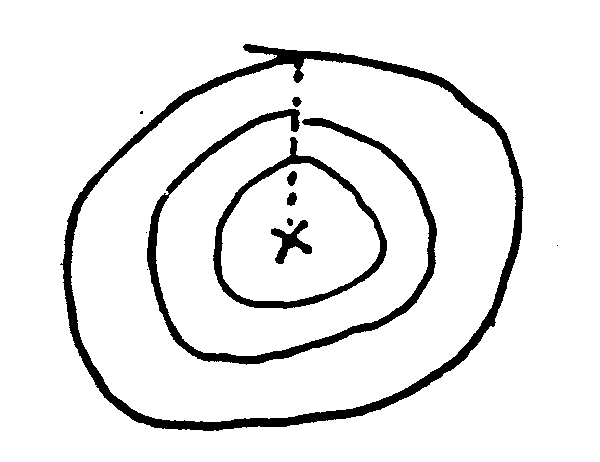
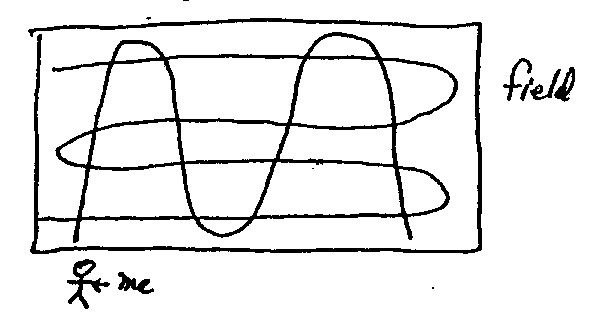

 The
people in question are teachers in Mozambique, who on a day-to-day
basis are confronted with the machinations of a disease which
turns reality on its head, requiring them to constantly examine
and re-examine their assumptions about who they are as individuals,
and about how the world works. These teachers - no doubt much
as everyone else in that part of the world - have been confronted
with increasingly complex levels of ambiguity because of the
overwhelmingly pervasive nature of this disease, affecting not
only individuals but also the very fabric and future of society
in social, economic, cultural and even political ways.
The
people in question are teachers in Mozambique, who on a day-to-day
basis are confronted with the machinations of a disease which
turns reality on its head, requiring them to constantly examine
and re-examine their assumptions about who they are as individuals,
and about how the world works. These teachers - no doubt much
as everyone else in that part of the world - have been confronted
with increasingly complex levels of ambiguity because of the
overwhelmingly pervasive nature of this disease, affecting not
only individuals but also the very fabric and future of society
in social, economic, cultural and even political ways. people who share a similar culture
or at least the same physical space; and c) and at a macro-collective
level, in other words between cultures and societies. Each of
these was expressed by these teachers in some way as the examples
below will illustrate.
people who share a similar culture
or at least the same physical space; and c) and at a macro-collective
level, in other words between cultures and societies. Each of
these was expressed by these teachers in some way as the examples
below will illustrate. disease
just from living with her. I wanted to help her because I could
see her suffering was terrible, but she would ask me to help
her bath because the itch from the disease was unbearable and
I would find many excuses not to help her, I was too scared that
her misfortune would pass on to me. I kept thinking that when
she would die I would be happy. Then she died and since then
I worry every time I cough, every time I have a small problem
with my skin, and I wait for my turn to die". At a very
fundamental level one finds here a conflict between beliefs about
the world (i.e. people should do good to one another) and the
reality of a disease that disturbs all such assumptions.
disease
just from living with her. I wanted to help her because I could
see her suffering was terrible, but she would ask me to help
her bath because the itch from the disease was unbearable and
I would find many excuses not to help her, I was too scared that
her misfortune would pass on to me. I kept thinking that when
she would die I would be happy. Then she died and since then
I worry every time I cough, every time I have a small problem
with my skin, and I wait for my turn to die". At a very
fundamental level one finds here a conflict between beliefs about
the world (i.e. people should do good to one another) and the
reality of a disease that disturbs all such assumptions. And
finally at a macro collective perspective there are the fundamental
inconsistencies that are somehow a reflection of how groups of
people - through their unceasing interaction, through the togetherness
that grows from having even the vaguest of common goals, and
through their common history - build some form of commonality,
be it a society, a nation, a revolution, a vision or whatever
label we may place on it at a given time. There are moments in
history when every attempt at addressing inconsistencies leads
to more war and chaos (we have only to look at the Middle East
to have a constant reminder of this). And then there are those
equally amazing moments where, in spite of the ambiguity within
and between individuals and collectivities, precisely those divisions
that may have been born out of frustration and anger become rivers
of inspiration and beauty. Those who have experienced the process
of post-independence nation building in former colonies, or who
have ever been in the middle of a major natural disaster may
recall to the bone the intensity and energy of such processes.
At such times bridges are built not only horizontally but also
vertically, as well as diagonally and in any direction possible,
and for a time each successive bridge appears to be stronger
than the last.
And
finally at a macro collective perspective there are the fundamental
inconsistencies that are somehow a reflection of how groups of
people - through their unceasing interaction, through the togetherness
that grows from having even the vaguest of common goals, and
through their common history - build some form of commonality,
be it a society, a nation, a revolution, a vision or whatever
label we may place on it at a given time. There are moments in
history when every attempt at addressing inconsistencies leads
to more war and chaos (we have only to look at the Middle East
to have a constant reminder of this). And then there are those
equally amazing moments where, in spite of the ambiguity within
and between individuals and collectivities, precisely those divisions
that may have been born out of frustration and anger become rivers
of inspiration and beauty. Those who have experienced the process
of post-independence nation building in former colonies, or who
have ever been in the middle of a major natural disaster may
recall to the bone the intensity and energy of such processes.
At such times bridges are built not only horizontally but also
vertically, as well as diagonally and in any direction possible,
and for a time each successive bridge appears to be stronger
than the last. many
of these teachers are painfully formulating their questions in
a resource-poor environment (they have nowhere to go to seek
for answers to their questions) where the HIV awareness campaign
focuses mainly on spoon feeding little bits of information and
promotes a sense of fatalism, and where there is not necessarily
a tolerance of the process of questioning that they embark upon.
For many the questions remain in their head and can not, given
the constraints of their environment, be consistently addressed.
many
of these teachers are painfully formulating their questions in
a resource-poor environment (they have nowhere to go to seek
for answers to their questions) where the HIV awareness campaign
focuses mainly on spoon feeding little bits of information and
promotes a sense of fatalism, and where there is not necessarily
a tolerance of the process of questioning that they embark upon.
For many the questions remain in their head and can not, given
the constraints of their environment, be consistently addressed.