Latest update of this page: September 25, 2004
Muriel Visser
I often find myself prefacing my answers to supposedly simple questions, such as where are you from, where did you grow up, what is it that you do, with the weighty and wavering word "well" as a way of qualifying all that will follow. In part this is probably because my childhood may be a little less than usual, growing up in Africa, going to school for the first time when I was nine, volunteering at a blood bank when I was 15, doing three quite different university degrees (in rural sociology, distance education and health communication) on an equal number of continents. But probably more importantly my use of the word "well" is a reflection of the fact that life is complex, that what is reality for one person may be fiction for another although they may technically share the same space and time, that our perception of ourselves and others is shaped by so many different factors that it is only possible to speak of what we have in common in very cautious terms, and that there is really no such thing as a straightforward solution or a simple problem.
 This
"mini philosophy" - if you can call it that - extends
to my professional life, a glimpse of which may be gleaned from
my resume. I don't believe
in simple answers or solutions. I do believe in the art of asking
questions, of constantly challenging the boundaries of what we
know and what we believe in by exposing ourselves to the unknown,
the incomprehensible, even to that which we abhor or which frightens
us. In a world where issues increasingly present themselves in
the form of dichotomies, I believe that the understanding that
comes from successively seeking, examining, accepting and disseminating
alternative and multiple realities and interpretations is, and
will continue to be, fundamental to human survival and development.
This
"mini philosophy" - if you can call it that - extends
to my professional life, a glimpse of which may be gleaned from
my resume. I don't believe
in simple answers or solutions. I do believe in the art of asking
questions, of constantly challenging the boundaries of what we
know and what we believe in by exposing ourselves to the unknown,
the incomprehensible, even to that which we abhor or which frightens
us. In a world where issues increasingly present themselves in
the form of dichotomies, I believe that the understanding that
comes from successively seeking, examining, accepting and disseminating
alternative and multiple realities and interpretations is, and
will continue to be, fundamental to human survival and development.
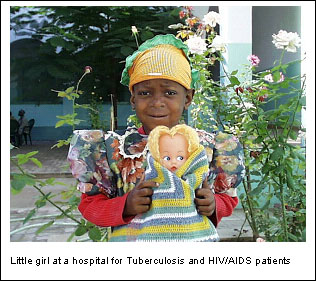
Humankind faces challenges far beyond those that are the immediate consequence of the complexity of human nature and human interaction. One of these challenges is the devastation, confusion and despair that are being brought on by the impact of the HIV/AIDS epidemic. Alarm bells regarding the potential impact of this disease were being rung - and largely ignored - as far back as the late 1980's, when I first started working in Africa. It was the confrontation with the impact of the disease - while working on various education and rural development initiatives in Mozambique in the 1990's - combined with my perplexity at the absence of a response by governments, institutions and individuals, as well as the experience of having a very close friend become affected by the disease, that strengthened my personal resolve to in some small way contribute to the fight against HIV/AIDS and the many factors (poverty, politics, violation of human rights) that facilitate the spread of the disease.
 Initially,
I attempted to address the (potential) impact of the disease
by integrating this concern in activities that I was already
working on in the field of education and rural development in
Mozambique. However, doing so made me increasingly frustrated
with the limited impact of these strategies and activities and
with my own lack of understanding of the complex interaction
of factors that can make rational and even well informed human
beings engage in irrational and potentially harmful behavior.
And so I decided to step away from what I had been working on
and to broaden and strengthen my skills by pursuing a Ph.D. in
communication at while actively (and concurrently with my
academic pursuits) engaging in various research and development
endeavors in the field of HIV/AIDS and other areas of health
related human behavior.
Initially,
I attempted to address the (potential) impact of the disease
by integrating this concern in activities that I was already
working on in the field of education and rural development in
Mozambique. However, doing so made me increasingly frustrated
with the limited impact of these strategies and activities and
with my own lack of understanding of the complex interaction
of factors that can make rational and even well informed human
beings engage in irrational and potentially harmful behavior.
And so I decided to step away from what I had been working on
and to broaden and strengthen my skills by pursuing a Ph.D. in
communication at while actively (and concurrently with my
academic pursuits) engaging in various research and development
endeavors in the field of HIV/AIDS and other areas of health
related human behavior.
A selection of topics that I have worked on over the past years can be found below, together with links to relevant abstracts, papers and publications, two of which can also be found in the "papers" section of the learndev.org site:
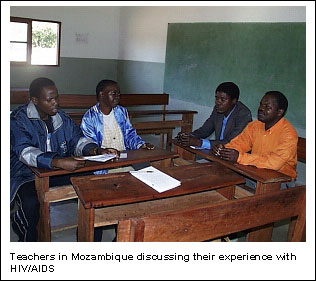
- Quantitative research into the factors that contribute to the willingness of teachers in Mozambique to talk about HIV/AIDS with their students and in their communities (dissertation on The impact of individual differences on the willingness of teachers in Mozambique to communicate about Hiv/Aids in schools and communities).
- Qualitative research into teachers' experience with HIV/AIDS (paper on Where teachers fear to tread).
- Materials development to enhance awareness and discussion of the impact of HIV/AIDS for students and educators (Papers for UNICEF on Teaching about HIV/AIDS; Life or lunch: What do we choose? - HIV/AIDS in the workplace; and Addressing the impact of HIV/AIDS, as well as a module on Learning about HIV/AIDS in Africa: What you need to know).
- Collection and analysis of learning stories that reflect the diversity of learning processes in health and other areas by people in rural communities in Mozambique (Paper with Jan Visser on We closed our books and put them away." Learning stories from Mozambique - A critical reflection about the reality and future of learning.).
- Content analysis of the portrayal of HIV/AIDS in the South African print media (Paper on The story behind the headlines –HIV/AIDS in a leading South African newspaper).
- Research into the impact of exposure to tobacco in the media on adolescent susceptibility to smoking (Paper co-authored with Laura M. Arpan and Gary R. Heald on Gender patterns and smoking susceptibility among adolescents who view actors smoking - Abstract).
- Research into adolescent attitude functions toward smoking and their impact on smoking behavior (Paper with Laura M. Arpan and Gary R. Heald on Functions of Attitudes toward cigarette smoking among adolescents: An initial investigation and possible implications for anti-smoking messages - Abstract).
 Concurrently,
I have continued to work as a consultant in education and health
in Mozambique for a number of international and bilateral organizations
(the French Development Agency, UNICEF, Irish Aid) as well as
for a local NGO (UDEBA - Gaza). For details, see my resume.
Concurrently,
I have continued to work as a consultant in education and health
in Mozambique for a number of international and bilateral organizations
(the French Development Agency, UNICEF, Irish Aid) as well as
for a local NGO (UDEBA - Gaza). For details, see my resume.
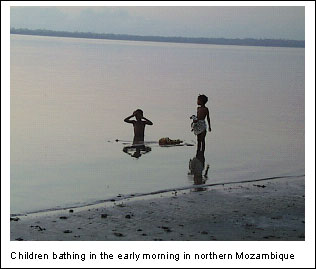
In addition to my professional
engagements, I very much enjoy photography as the pictures that
I have included here testify.
In the coming years I hope to continue to explore some of the
questions that have kept me busy so far. Not because I have come
any closer to an answer - life is not as simple as that - but
because what I have learnt so far has convinced me that addressing
the challenges we face, such as those of the HIV/AIDS pandemic,
requires that we continue to ask questions beyond our own, often
simplistic, interpretation of the world. It is in this context
that I elaborated a concept paper for research and activities
in the domain of HIV/AIDS for the Learning Development Institute.
It can be found on the relevant page for the Attitudinal
and Behavioral Change (ABC) area of activity of this Web
site. In the spirit of much of what LDI does, this is an on-going
initiative which you are invited to examine and comment on.